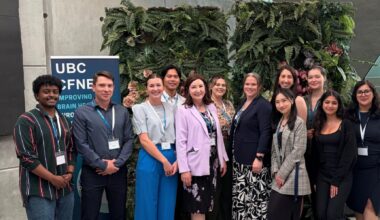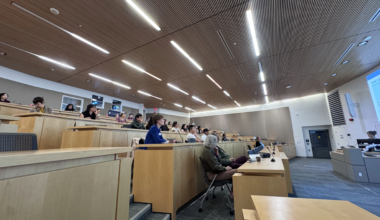
On April 20, 2026, UBC Connects at Robson Square and the Djavad Mowafaghian Centre for Brain Health (DMCBH) hosted Repairing the Mind: The Future of Brain Injury Research and Recovery — an evening for community members and researchers to come together to explore how blood tests, personalized recovery treatment and technologies that help unconscious patients to communicate are opening new pathways for neuro-recovery.
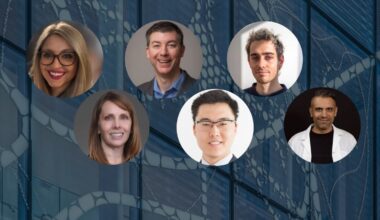
Presented in partnership with UBC Community Engagement, leading UBC scholars Dr. Cheryl Wellington, Dr. Wolfram Tetzlaff and Dr. Stefanie Blain-Moraes from DMCBH highlighted the complexity of brain and spinal cord injuries and the innovative approaches for diagnosis and treatment.
Using blood tests to diagnose brain injuries
Dr. Cheryl Wellington opened the evening with a talk about how advances in the use of simple blood tests could transform the future of traumatic brain injury (TBI) care. TBI is highly variable, ranging from mild concussions to severe, life-threatening injuries and current diagnostic tools, like the Glasgow Coma Scale, can be subjective and limited, particularly for milder cases. Dr. Wellington’s research aims to create better detection tools by looking for proteins that are released by damaged brain cells into the bloodstream.
This new approach could offer faster, more objective ways to diagnose and treat brain injuries. By developing tools that can be adjusted for a patient’s age and studying the precision across large populations, her team is showing how biomarkers can guide better, more precise clinical decisions—for instance, when imaging is needed, how well recovery is progressing over time, and what long-term risks may exist.
She also highlighted the development of the new Core Facility for Neurology Biomarker Innovation (CFNBI) at the DMCBH, which is dedicated to advancing the use of blood tests for neurological disorders, positioning UBC at the forefront of this work.
Regenerating the spinal cord by “mending the gap”
The second talk by Dr. Wolfram Tetzlaff shifted the focus to spinal cord injuries (SCI), neurological conditions that cause more than just paralysis; they often disrupt vital functions like breathing, blood pressure and bladder control. While current treatments focus on primarily stabilization, surgery, and rehabilitation, they often fall short of a full recovery. While emerging technologies such as electrical stimulation and brain-computer interfaces show promise in restoring some limited function, the ultimate goal of complete repair remains elusive.
To bridge this gap, Dr. Tetzlaff and the interdisciplinary team at the Mend the Gap project are developing smart biomaterials: injectable gels embedded with magnetic microstructures designed to span injury sites and support nerve regrowth. While early results in animal models are encouraging, significant hurdles remain. Describing recent advances as baby steps toward the field’s “holy grail,” Dr. Tetzlaff stressed that collaborative research remains a vital ingredient for achieving the ultimate goal of a full recovery.
Detecting consciousness and restoring connection
Dr. Stefanie Blain-Moraes concluded the evening by asking the profound question of “Is anyone home?” for individuals rendered non-communicative due to severe brain injury, ALS, or end-of-life conditions. She explored the concept of consciousness as a subjective inner experience, noting that traditional bedside assessments often fail to detect it. Recent neuroimaging findings have revealed that up to 25 per cent of behaviourally unresponsive patients may still be aware and able to follow commands using only their brain activity, a phenomenon known as cognitive-motor dissociation.
To address this, Dr. Blain-Moraes’ work aims to better detect and predict the recovery of consciousness using tools such as EEG and anesthesia-based “stress tests,” while promoting neuroplasticity through non-invasive brain stimulation. She emphasized that repairing the mind ought to extend beyond neural activity to also encompass relationships and personhood. Her lab’s Biomusic technology translates physiological signals into sound, allowing caregivers to hear the emotional or internal states of minimally communicative individuals. This approach goes beyond standard clinical care and fundamentally shifts how caregivers perceive these patients, reinforcing their humanity and presence even in the absence of an outward response.
The future of neuro-recovery
Together, the talks illustrated a turning point in brain injury research and care, from limited, often reactive treatments toward more precise diagnostics, regenerative strategies and holistic approaches that integrate science with human connection. Many of these innovative approaches are still in their early phases of development, but it’s clear that repairing the mind requires not only scientific breakthroughs, but also a deeper commitment to understanding consciousness, recovery and what it means to remain present in the world.
As the evening concluded, the message was clear: modern research is no longer just about saving lives, but about improving the quality of those lives. Whether through a pinprick blood test or a technology that gives a voice to the silent, the goal is to repair not just the biological brain, but the social and emotional life of the person within.