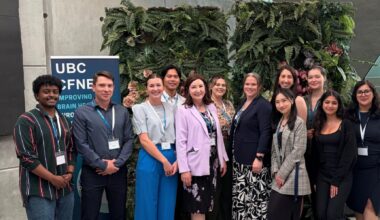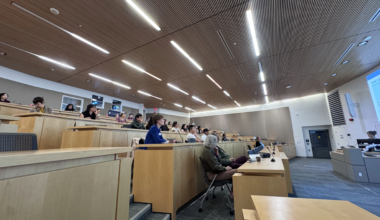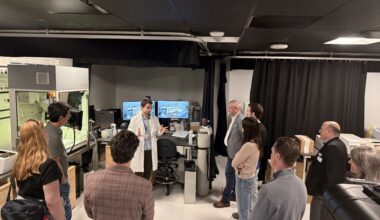
On April 17, 2026, researchers, clinicians, trainees and community members gathered at the Djavad Mowafaghian Centre for Brain Health (DMCBH) for a panel event called “Innovative Approaches to Opioid Use Disorder Management in the Fentanyl Era,” co-sponsored by the MATRIX-N research cluster and DMCBH.
The event took place just days after the 10-year anniversary of British Columbia’s declaration of the toxic drug crisis as a public health emergency, highlighting the need for innovative solutions to this long-standing and evolving crisis.
Leading Experts in OUD: A multidisciplinary panel
The panel brought together leading experts to discuss emerging challenges in opioid use disorder (OUD) care in the midst of the evolving drug toxicity crisis and explore innovative approaches to research, clinical practice and public health solutions. This was a multidisciplinary panel that brought together many unique perspectives on this topic.
Dr. Kelly Dunn joined from the University of Maryland, where she is a Professor of Psychiatry and Director of the Kahlert Institute for Addiction Medicine. Dr. Dunn has been working in the OUD field since 2005 and is one of the leading researchers on this topic in the US. Her research focuses on identifying and evaluating methods to prevent and treat OUD, and her extensive clinical trial work on emerging OUD medications brought an invaluable perspective to the panel.
Dr. Glenn Sammis is a professor of Chemistry at UBC, working on innovative synthetic methods for pharmaceutical development and contributes to the development of a novel opioid detection device. Dr. Sammis brought a chemical innovation perspective on the opioid crisis to the panel, highlighting how advances in chemistry can support both safer drug development and improved tools for identifying toxic substances in the drug supply.
Dr. Adam Haar Horowitz joined us from Massachusetts, where he is a research affiliate at MIT (Media lab) and Harvard Medical School (Center for Sleep and Cognition). Dr. Haar Horowitz co-founded the field of dream engineering, and is the CEO of Dust, which aims to translate dream science into tools that improve creativity and mental health. He provided an insightful perspective on how insomnia and dream science may inform novel approaches to OUD and addiction treatment.
Dr. Victor Li is a concurrent disorder psychiatrist working at the Complex Pain and Addiction Services (CPAS) at Vancouver General Hospital (VGH) and also works at the UBC Hospital Mood Disorders Clinic. Dr. Li’s experience offered invaluable insight into the realities clinicians face day-to-day, highlighting both the most pressing challenges and the most promising paths forward.
Na’im Newman-Azar, an average 15-year old and high school student, joined the panel to provide a youth perspective on substance use patterns and trends, offering insight into the unique challenges and pressures faced by today’s adolescents and bringing an important new dimension to the discussion.
Dr. Martha Ignaszewski is a Harvard and UCSF trained psychiatrist who serves as the Senior Medical Director of Substance Use and Concurrent Disorders in the Department of Child and Adolescent Psychiatry at BC Children’s Hospital, Clinical Lead of SURF, and Senior Medical Director of Mental Health and Substance Use at BC Women’s Hospital. Dr. Ignaszewski’s clinical and research work focuses on youth development and the intersection of addiction and concurrent disorders, bringing a critical perspective to the panel.
Dr. Pouya Azar is a clinician-scientist in addiction psychiatry. He serves as Co-Medical Manager of CPAS, Clinical Assistant Professor at UBC, and Director of the VGH Concurrent Disorders Fellowship. He also works as a pain physician at the VGH Transitional Pain Clinic. Dr. Azar’s research focuses on developing innovative opioid agonist and other treatment protocols for OUD. Dr. Azar moderated the discussion, drawing on both his clinical and research expertise to guide conversation around the most pressing and emerging challenges in the field.
Challenges in the fentanyl area: Playing catch-up
The panelists began by discussing how the evolving introduction of increasingly potent opioids in the illicit drug supply continues to complicate our scientific and clinical understanding of OUD management and discussed where current treatment paradigms fall short.
Dr. Azar opened the discussion with a powerful statement that encapsulates the current challenges: “We realized that the tools we had to treat patients with opioid use disorder in the heroin era were less and less relevant… We very quickly found ourselves in an evidence void.”
Other panelists echoed this concern, noting that current management guidelines and technology were based on a fundamentally different drug supply. With continued evolution of the unregulated drug market, the panelists felt as though we have been “playing catch up” for years and have faced an immense pressure to innovate in a short period of time. As Dr. Dunn worded it, “we have to figure out in real time, as we are losing people, how we can best meet their needs.”
Looking forward: Potential solutions
Despite these challenges, panelists emphasized the importance of collaboration, innovation, and rethinking traditional approaches to OUD care.
One key discussion point was the value of targeting universal symptoms of OUD, rather than treating them in isolation. Many OUD patients are polydrug users (i.e., use multiple substances) and symptoms of OUD and other substance use disorders share many commonalities such as craving, mood, and insomnia. These shared factors may have similar neurobiological mechanisms and understanding more about what patients are experiencing overall could be key to improving OUD patient outcomes. Dr. Dunn suggested that this may be why some promising discoveries fail to translate into clinical practice, as they may not be fully representative of the population they are treating.
The discussion shifted to opioid agonist therapy (OAT) and what approaches were most promising in the current landscape. OAT, which replaces illicit opioids with safer, long-acting, and more controlled prescription opioids, has become much more difficult in the fentanyl era compared to the heroin era. Increasing opioid potency has raised tolerance levels beyond what traditional OAT can meaningfully replace. As such, there is growing urgency to initiate patients on higher doses and OAT solutions that can accomplish this will be the most effective.
Attendees chime in!
The audience Q&A highlighted some additional challenges and solutions that nicely complemented the panelist discussion. The multifaceted and insightful discussion ranged from challenges with innovation and adapting systems of care in psychiatry to the potential of orexin medications in treating withdrawal. The panel was followed by a social hour where attendees continued their conversations and had some food and drinks.

Written by Stefanie Todesco, MATRIX-N Junior Scholar