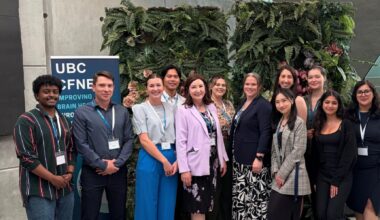
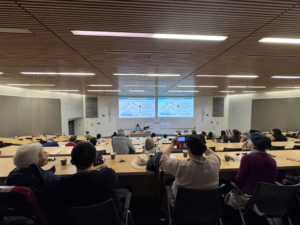
On May 9, 2026, the Dementia LINK team hosted its inaugural Open House at the Djavad Mowafaghian Centre for Brain Health (DMCBH) at UBC. The event brought together approximately 60 participants, including community members, patient partners, caregivers and researchers, in the spirit of fostering meaningful dialogue between the scientific community and the public it serves.
Dementia LINK’s purpose is to link innovation to knowledge translation. This event provided an opportunity for those with lived experience of dementia to learn more about the biomedical side of dementia research in a welcoming, relaxed and accessible environment.
Featured Knowledge Translation Presentations
The program opened with presentations from three principal investigators whose work spans the mechanisms, diagnosis and treatment of Alzheimer’s disease:
Dr. Annie Ciernia opened the scientific session with a presentation titled How Gut Bacteria Affect Alzheimer’s Disease Progression, addressing cellular and molecular processes that drive neurodegeneration and grounding the subsequent presentations in the fundamental science that informs translational and clinical work.
Dr. Cheryl Wellington followed with a talk titled Development of Blood Tests for Dementia, highlighting how innovations in early and accurate detection are central to improving patient outcomes and enabling timely intervention.
Dr. Khaled Abdelrahman closed the presentation series with a talk titled Exploring New Treatment Options for Alzheimer’s Disease, discussing ongoing work in drug development and the therapeutic avenues currently under investigation.
The formal presentations were followed by a moderated panel discussion and open audience Q&A, offering participants the opportunity to engage directly with the researchers. The session concluded with closing remarks from Jen Lyle, CEO of the Alzheimer Society of BC and Yukon, who spoke to the importance of bringing community members and researchers together.
Networking Lunch and Laboratory Tours
The afternoon program began with a catered lunch in the DMCBH’s third floor meeting rooms, providing an informal setting for continued discussion among researchers, trainees, community members and patient partners. 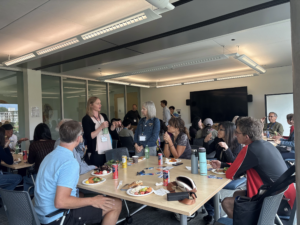 This segment of the day proved valuable for building cross-disciplinary connections and facilitating the kind of dialogue that structured programming alone cannot always achieve.
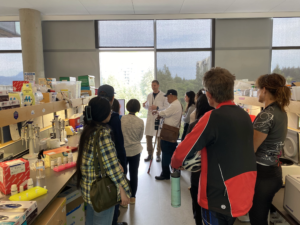
Following lunch, participants were invited to join optional laboratory tours, divided into three groups and led by trainees through three research lab spaces on the 4th and 5th floors of the DMCBH. The tours offered direct exposure to the research infrastructure and methodologies employed in active dementia research programs, providing community participants with a tangible understanding of the scientific process.
Event Feedback
Immediately following the event, participants were provided the opportunity to fill out a feedback form on the event to comment on their favourite parts and suggestions for future events. Overall responses were highly positive, with participants identifying the researcher presentations as their favourite component of the day, followed closely by the laboratory tours. Many participants commented on how they found the presentations very informative, while also being easy for the general public to follow. A selection of anonymous participant feedback illustrates the breadth of what resonated:
“Excellent science communication!”
“The topics and presentations were very informative and very hopeful for the future of Alzheimer’s”
“The presentations covered a range of interesting topics and the lab tours were a great follow up to see more research in action!”
“The lab tours, as I was really able to engage with the research and put it into the context of lived experience.”
“The humour and personable nature of everyone we met.”
These responses reflect the event’s success in achieving its core knowledge translation mandate, making research meaningful, relevant and accessible to those most affected by dementia.
Looking ahead, a number of participants expressed interest in a longer panel discussion to allow for more sustained back-and-forth with the researchers. This feedback speaks to the depth of engagement among attendees and the genuine appetite many people with lived experience have for continued involvement in the research process, which is something the Dementia LINK team looks forward to building on in future events.
Acknowledgements
The Open House was made possible through the Michael Smith Health Research BC patient, public and community partner engagement fund, awarded to Dr. Abdelrahman, who co-led the organization of the event alongside Jennifer Cooper and Sanarya Al-Jaf. Sarah Wu of the Alzheimer Society of BC and Yukon provided additional organizational support. In particular, the Alzheimer Society played a particularly important role in outreach, helping to advertise the event widely to community members and ensuring it reached those who benefit most from research translation initiatives of this kind.
The success of this event reflects the dedication of a large team of volunteer trainees who contributed their time and expertise on the day of the event. Sincere thanks are extended to: Jennifer Cooper, Sanarya Al-Jaf, Isabella DiBerardino, Rachael Smith, Dana Go, Kidus Achalu, Tetiana Poliakova, Mohammad Ghodsi, Simren Ahuja, Emily Ye, Jatin Agnani, Jordan Hamden, Thomas Florkin and Catalina Pascualy.
The Dementia LINK team is incredibly grateful to all participants who attended. Their engagement, curiosity, and willingness to participate in the Q&A and laboratory tours exemplified the spirit of patient-oriented research that we aim to advance.