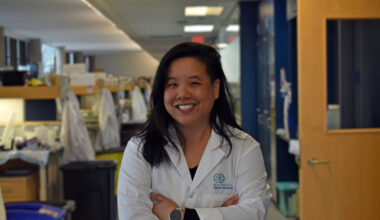
Inspired by the goal of helping people regain movement and sensation after a nervous system injury, Dr. Ashley Dalrymple brings a unique perspective that combines engineering, neuroscience and rehabilitation science to address some of the most complex challenges in neurological recovery.
Dr. Dalrymple recently joined UBC as an Assistant Professor in the Department of Physical Therapy and Canada Research Chair in Spinal Cord Neuromodulation. She is also a principal investigator at the International Collaboration on Repair Discoveries (ICORD) and a member of the Djavad Mowafaghian Centre for Brain Health.
As Director of the Neural Engineering and Rehabilitation Via Electrical Stimulation (NERVES) Lab, Dr. Dalrymple leads an interdisciplinary team that combines engineering, neuroscience, computing science and rehabilitation to better understand the nervous system and develop technologies that support recovery after injury.
“I enjoy applying engineering solutions to neuroscience and rehabilitation problems,” she says. “To me, it’s a pragmatic approach to helping people.”
From engineering to neuroscience
Originally from Wetaskiwin, Alberta, Dr. Dalrymple’s path to neuroscience was not a direct one. As a child, she dreamed of becoming a forensic scientist. It wasn’t until high school, when she discovered a passion for physics and calculus, that she decided to pursue engineering.
A self-described “first-generation nerd,” Dr. Dalrymple was the first person in her family to earn a bachelor’s degree. She completed a Bachelor of Science in Electrical Engineering with a biomedical specialization, followed by a PhD in Neuroscience at the University of Alberta. Her training continued through postdoctoral fellowships at the Bionics Institute in Australia, the University of Pittsburgh and Carnegie Mellon University. Most recently, she was an Assistant Professor at the University of Utah.
Throughout her academic journey, she remained drawn to the intersection of technology and human health.
“I have always wanted to be a scientist, but it was important to me to merge my training and my passions,” she says. “I loved the combination of medicine and engineering and couldn’t see myself doing anything different.”
Fascination with the spinal cord
Early in her career, she became fascinated by one part of the nervous system in particular: the spinal cord.
“It’s an intricate control system that integrates inputs from the body and supraspinal regions to coordinate movement,” she explains. “It’s more complicated than many people think, and I want to understand how it changes in response to injury and how we can tap into these networks to improve sensory and motor function.”
That curiosity continues to drive her research today and has shaped the mission of the NERVES Lab.
Developing technologies to improve recovery
While her lab’s projects span several areas, they are united by the common goal of improving walking and sensorimotor function after nervous system injury.
Her team investigates novel implanted and external neural interfaces, studies how the spinal cord adapts following injury, applies machine learning approaches to control movement and explores how sensory feedback influences motor outputs. Their research spans exploratory, proof-of-concept, preclinical and clinical studies, helping bridge the gap between fundamental discovery and real-world patient impact.
Dr. Dalrymple is particularly excited about how advances across these areas are beginning to converge.
“Our lab has several arms of research, but they all contain elements of spinal cord stimulation and walking,” she says. “I am most excited about seeing how our body of work comes together, using knowledge gained and technological advances to culminate in a solution where we can provide adaptive and personalized restoration of sensation and movement after injury to the nervous system.”
She believes the field of neurotechnology is entering an especially exciting period. Rapid advances in neural interfaces, computing and artificial intelligence are creating new opportunities to develop more effective and personalized therapies.
“There is a lot of industry and public excitement about neurotechnologies right now,” she says. “We have a lot of foundations to build off of, and I think that as we get more buy-in from clinical providers, we can make major strides in helping people.”
Life beyond the lab
Outside the lab, Dr. Dalrymple enjoys a variety of hobbies, ranging from travelling, weightlifting and crafting to cooking, baking and binge-watching television shows. Since moving to Vancouver, she has also discovered a new appreciation for one of the city’s most iconic springtime sights.
“I am in love with cherry blossoms,” she says. “I had not seen them before moving to Vancouver. They are like little cotton candy trees.”
This summer, she is also looking forward to getting out on the water with her new paddleboard.
As she establishes her research program at UBC, Dr. Dalrymple is excited to collaborate with researchers, clinicians and trainees across disciplines to advance next-generation neurotechnologies. By combining engineering innovation with rehabilitation science, she hopes to help unlock new possibilities for recovery and improve quality of life for people living with neurological injuries.