Growing up, Dr. Jeff Dong always enjoyed science subjects at school, so he knew he wanted to pursue a career in STEM. In particular, he credits his high school biology teacher who inspired him to further study life sciences at UBC as an undergraduate student and later as a graduate student. This decision ultimately set him on a path to becoming a research scientist.
“It was sort of like a positive feedback loop,” Dr. Dong explains. “Science and research were areas that excited me the most and because of this, I was motivated to develop the relevant knowledge and skills, which in turn propelled my career development.”
Ironically, studying immunology wasn’t love at first sight.
“I actually did poorly in my introductory immunology course,” he recalls with a laugh. “But I was compelled to prove to myself that I could learn it and so I signed up for all the other immunology courses offered by the program. In the end, I was fascinated by how fundamental immunology research can reshape health care outcomes and wanted to contribute to that as I developed my career.”
That determination has become a defining feature of his scientific career.
Chasing the thrill of discovery
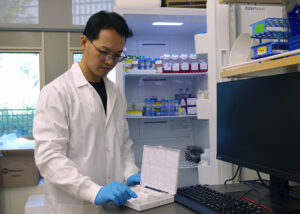 As an undergraduate studying microbiology and immunology, Dr. Dong discovered how rewarding research could be while working in the laboratory of former UBC professor Dr. Stephanie Borgland.
“Discovering something new gave me a bit of a dopamine hit,” he notes. “Which is funny because the Borgland lab studied what controls motivation and reward in the brain.”
Inspired by those early research experiences, he stayed at UBC to complete his PhD in microbiology and immunology under the supervision of Dr. Pauline Johnson. His doctoral research examined how a key protein on the surface of macrophages, which are specialized immune cells, interact with hyaluronan (an important component of lung tissue) to regulate immune responses.
He later expanded his research into the brain during a postdoctoral fellowship with Dr. Wee Yong at the University of Calgary, where he investigated the mechanisms driving neuroinflammation and neurodegeneration in multiple sclerosis (MS). He then established his independent research program at the University of Saskatchewan before recently returning to UBC as an Assistant Professor in the Department of Microbiology and Immunology.
Investigating the immune system’s role in brain health
Today, Dr. Dong’s laboratory studies how the immune system contributes to neurodegenerative diseases such as MS.
His research focuses on oxidized phosphatidylcholines (OxPCs), molecules that are produced when lipids in cells are damaged by oxidative stress. These molecules accumulate in brain lesions in people living with MS, but Dr. Dong’s work has shown they are much more than markers of disease.
He discovered that OxPCs play an active role in driving neurotoxicity. His work has also revealed that microglia, which are the brain’s resident immune cells, can remove these harmful molecules, helping protect the nervous system. However, aging appears to weaken this natural defence, which may help explain why MS often becomes more progressive later in life.
By studying these mechanisms, Dr. Dong hopes to uncover new ways to slow or prevent neurodegeneration. His lab is investigating how everyday factors such as diet and exercise influence oxidative damage in the brain, with the goal of identifying lifestyle interventions that could reduce disease risk. In addition, his team is also exploring therapies that use antibodies to neutralize OxPCs before they can damage brain tissue.
Looking ahead, Dr. Dong is excited by the rapid pace of discovery across the field of immunology.
“There’s an unprecedented amount of interdisciplinary knowledge being generated,” he says. “It’s exciting to think about how that could lead to the development of new immunomodulatory treatments for chronic diseases that were previously considered untreatable.”
A full-circle return to UBC
Returning to UBC as a faculty member has been especially meaningful.
“I’ve always looked back on my time in the department with great fondness,” he says. “So being able to join the faculty is fantastic and full-circle in many ways. I’m very grateful.”
As he builds his research program, Dr. Dong is looking forward to collaborating with the Djavad Mowafaghian Centre for Brain Health and UBC’s vibrant community of neuroscientists and immunologists. He is particularly interested in exploring connections between the respiratory system and the brain, including how immune activity in the nasal cavity may influence neurological health.
Advice for future scientists
Just as he benefited from the guidance of mentors throughout his career, Dr. Dong is committed to supporting the next generation of scientists.
“Ultimately, I hope to help my trainees achieve their goals, do some cool science, and work to improve the health of Canadians.”
For students considering a career in research, Dr. Dong encourages them to stay curious and embrace challenges.
“Follow your passion and ask questions,” he says. “Maintain good work ethics and credibility. Be persistent and resilient when challenged by roadblocks. Find your peace in work-life integration and deliberately prioritize your commitments.”