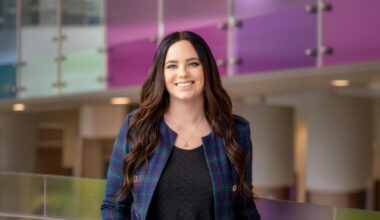
As a child, Dr. Callista Yee wanted to become an oncologist. Her older brother had childhood cancer and watching the physicians who cared for him inspired her to pursue a career where she could make a difference in people’s lives.
“I wanted to pay that forward,” she says. “And so I developed an interest in STEM and medicine from a young age.”
With a little parental pressure to pursue a traditional professional career, she followed a familiar path toward medical school at the University of Waterloo. However, while she was working on completing all of the pre-med courses, one particular class changed everything.
“I took developmental biology, and it completely derailed my career plans,” she recalls with a laugh. “I became fascinated by how a single cell can develop into an incredibly complex organism. I thought it was the coolest thing in the world.”
That curiosity eventually led her away from medicine and into research, and ultimately neuroscience, where she became fascinated with how neurons build and maintain connections with each other.
Now, an Assistant Professor in UBC’s Department of Zoology and a member of the Djavad Mowafaghian Centre for Brain Health (DMCBH), Dr. Yee is combining genetics, genomics and advanced microscopy to investigate the molecular blueprint that guides synapse formation, in hopes of one day discovering new therapeutic targets for neurological disorders.
Finding her way into research
Dr. Yee’s journey into research wasn’t straightforward. Since she had spent much of her undergraduate degree preparing for medical school, she had very little research experience when she began applying for graduate programs.
“I was pretty late getting into research,” she notes. “Many professors didn’t even consider me because I didn’t have any lab experience.”
Eventually, she found a professor at Toronto Metropolitan University, Dr. Marie Killeen, who gave her an opportunity to pursue a master’s degree in developmental biology. During one of their first meetings, Dr. Killeen introduced her to C. elegans, a tiny transparent roundworm widely used as a model organism in research.
“I was completely blown away by the fact that you could visualize neurons in a living organism without any special processing,” she says. “That was really what sparked my interest in neuroscience.”
Today, C. elegans remains at the heart of her research.
Decoding the brain’s connections
Neurons communicate with one another through specialized structures called synapses. These connections are essential for everything from movement and sensation to learning and memory. While scientists have learned a great deal about the structure and composition of synapses, much less is known about the mechanisms that control synaptic gene expression.
Dr. Yee’s lab is working to fill that gap.
“We’re interested in understanding the genetic programs that tell neurons how to build and maintain these connections,” she explains. “If we understand those molecular instructions, we can begin to identify pathways that may be disrupted in different neurological disorders.”
Her lab recently discovered a previously unknown transcriptional program that links neuronal activity with synaptogenesis (the formation of synapses). This work was among the first to demonstrate how activity and developmental transcription factors work together to shape synapses in a living organism.
Now, her team is asking an even bigger question: how do neurons maintain these critical connections over an entire lifetime?
“Neurons are unique because they are post-mitotic, meaning they don’t divide,” she says. “They have to survive for decades while adapting to aging, stress and damage. We’re interested in understanding how they build these connections early in life and how they keep them functioning throughout the lifespan.”
By studying how neurons regulate synaptic proteins at the level of individual cells, her lab hopes to uncover fundamental mechanisms that support healthy brain function.
A collaborative home at UBC
As a new faculty member, Dr. Yee says one of the things she appreciates most about UBC is its collaborative research culture.
“The community here is incredibly synergistic,” she says. “People genuinely want to work together, and that’s something I really value.”
Although she is based at the Life Sciences Institute, she has already formed many interdisciplinary connections with researchers from the DMCBH and the Edwin S.H. Leong Centre for Healthy Aging. She is also developing projects that use C. elegans to model disease-associated genetic variants found in Indigenous populations.
“Being back in Canada has given me opportunities to pursue research related to Indigenous health and that’s something I’m really excited about,” she says.
For Dr. Yee, bringing together researchers with different expertise often leads to the most creative solutions.
“I think some of the best science happens when people come together to solve problems from different perspectives.”
Creating opportunities for future scientists
Getting a chance to join a research lab transformed Dr. Yee’s own career, and it has shaped how she mentors students today. She believes scientific success depends on far more than grades or publication records.
“Science certainly requires hard work,” she says. “But it also comes down to opportunity, and sometimes luck. Publications don’t tell the whole story about someone’s potential.”
She is especially passionate about making research more accessible and creating opportunities for students from diverse backgrounds.
“We need to increase accessibility to science,” she says. “There are so many people who don’t know how great science is because they were never given the chance.”
Her lab embraces collaborative problem-solving, encouraging everyone to contribute ideas rather than working in isolation. Also inspired in part by Indigenous ways of knowing, she values approaches that bring together different perspectives to tackle complex questions.
Sharing the excitement of discovery
Whether she is mentoring students, teaching cell biology or speaking with members of the public, Dr. Yee finds the greatest reward in helping others discover the excitement of science.
“I love seeing someone go from having no idea what you’re talking about, to having it all click,” she says. “Getting people excited about science is one of my favourite parts of the job.”
Her advice for students looking to pursue research reflects her own experience.
“Take the time to learn about what different labs are doing and find something that genuinely excites you,” she advises. “People can tell when you’re truly enthusiastic. If you’re curious and passionate, you’ll find a place where you belong.”
Outside the lab, Dr. Yee is embracing life on Canada’s west coast, from exploring the city’s cycling routes to sampling its diverse food scene.
“I’m really into gravel and cyclocross biking,” she says. “And I’ve also been plotting donut crawls across the city.”
For someone whose career was transformed by following an unexpected curiosity, it’s perhaps fitting that she’s happiest when exploring new paths. As her research continues to uncover the genetic instructions that build the brain’s connections, she is helping illuminate how those connections support brain health across the lifespan.