When you close your eyes and touch your nose with your finger, you’re relying on a sense you may rarely think about, called proprioception. Often described as the body’s sixth sense, proprioception allows us to perceive the position of our limbs and how they move, even without looking at them.
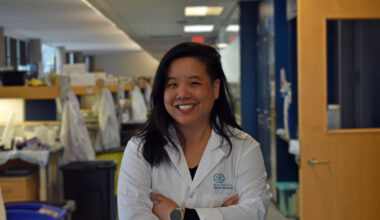
For Dr. Sweta Agrawal, an Assistant Professor in Comparative Physiology in UBC’s Department of Zoology and a member of the Djavad Mowafaghian Centre for Brain Health, understanding this sense is central to understanding how the nervous system controls movement.
The importance of proprioception
“I’m really interested in understanding the neuroscience of how we move through the world,” she says. “Proprioception depends on sensory neurons that are embedded in our muscles, joints and skin that provide information about the body’s position and movement.”
The nervous system uses this information to coordinate muscle activity, allowing us to reach for objects, walk and perform everyday actions. However, despite its importance, proprioception remains less understood than senses such as vision and smell. Much of its neural processing occurs in the spinal cord, where the underlying circuits can be difficult to access and study. Yet disruptions to proprioception can have serious consequences, even when the muscles themselves remain functional.
“Without proprioception, people aren’t able to coordinate the movement of those muscles in the right sequence to move properly,” Dr. Agrawal explains. “However, there isn’t a particular disease that you can point at that’s associated with its loss.”
Proprioceptive function may be affected by peripheral neuropathy, affecting the function of peripheral sensory neuron, or certain autoimmune conditions and chemotherapy drugs. Researchers also suspect that aging and neurodegenerative conditions, such as Parkinson’s disease, can also affect the proprioceptive system.
“The truth is, we don’t really know the cause because few have really thought to look,” she says. “Most research in humans has focused on what’s happening on the motor side and not so much on the sensory side.”
Using fruit flies to uncover neural circuits
Dr. Agrawal investigates the neural circuits underlying proprioception using Drosophila, commonly known as fruit flies. Although fruit flies are very different from humans, they offer researchers valuable ways to study how sensory information is processed and translated into movement.
Unlike vertebrates, which have an internal skeleton surrounding and protecting the spinal cord, fruit flies have an external skeleton that makes their nervous system more accessible for experiments. Researchers can also take advantage of the extensive genetic tools developed by the fruit fly research community to identify specific neurons, manipulate their activity and record how they respond in awake, behaving animals.
Dr. Agrawal’s lab uses these genetically modified flies to label different subsets of neurons, helping the team investigate the roles of individual cells and neural circuits in movement control.
Another important resource in her work is the fly connectome, a detailed map of neural connections in the fly central nervous system. By combining this anatomical information with experiments that measure neural activity and behaviour, researchers can investigate how proprioceptive signals are processed throughout the nervous system.
Dr. Agrawal is particularly excited by a broader shift in neuroscience toward studying the brain in the context of the body and its environment.
“I love that more and more, people are working with embodied models and trying to place their neuroscience in the context of the actual world,” she says.
The brain does not operate in isolation, she explains. It must coordinate with muscles, respond to gravity and adapt to a changing environment, often while managing several functions at once. Studying animals as they move and interact with the world can therefore reveal aspects of neural function that may be missed in more isolated experimental settings. For Dr. Agrawal, research in non-traditional model organisms offers exciting opportunities to uncover how neural circuits work.
A path shaped by curiosity
Dr. Agrawal joined UBC as an Assistant Professor earlier this year, bringing her research program to Vancouver from Virginia Tech, where she established her lab in 2023. Prior to that, she completed her doctoral and postdoctoral training at the University of Washington.
Her interest in biology began at a young age, although she did not initially know what a career in science would look like. As an undergraduate, she explored several areas of biology, from yeast genetics to ion channel physiology and neuroethology, before focusing on neuroscience.
“I was interested in biology from a pretty young age in spite of my family’s expectations to pursue medicine,” she recalls. “Then in high school, I discovered the brain and neuroscience and ended up pursuing it for both my undergrad and PhD.”
That curiosity continues to shape how she approaches research and how she encourages students to explore science. Her advice to students is to seek out a wide range of ideas and perspectives, rather than limiting themselves to familiar topics.
“Read and go to a lot of talks — it’s the best way to practice science comprehension and seeing what people tend to think and talk about,” she says. “You never know what might end up fascinating you and impacting your work.”
She also encourages students to attend scientific meetings, explore posters outside their immediate areas of interest and find opportunities to engage in the community.
“Talk about your science both with scientists and non-scientists. You’ll get better at talking about your work, and you’ll help others understand what science really is and how it gets done,” she advises.
Beyond the lab
Outside the lab, Dr. Agrawal enjoys mushroom hunting and learning about mycology, the study of fungi. While living in Seattle, she was active in the Puget Sound Mycological Society, leading field trips and exploring the woods in search of mushrooms.
In Vancouver, she is looking forward to exploring the region’s natural surroundings and diverse communities. Among the things she enjoys most about the city are the mountains and amazing natural beauty, in addition to the diversity of people and food.
As she establishes her research program at UBC, Dr. Agrawal brings a fundamental question to the study of brain function: how does the nervous system use information from the body to produce movement? By investigating the neural circuits that support the often-overlooked sense of proprioception, her work aims to advance our understanding of how our brains and bodies work together to navigate the world.