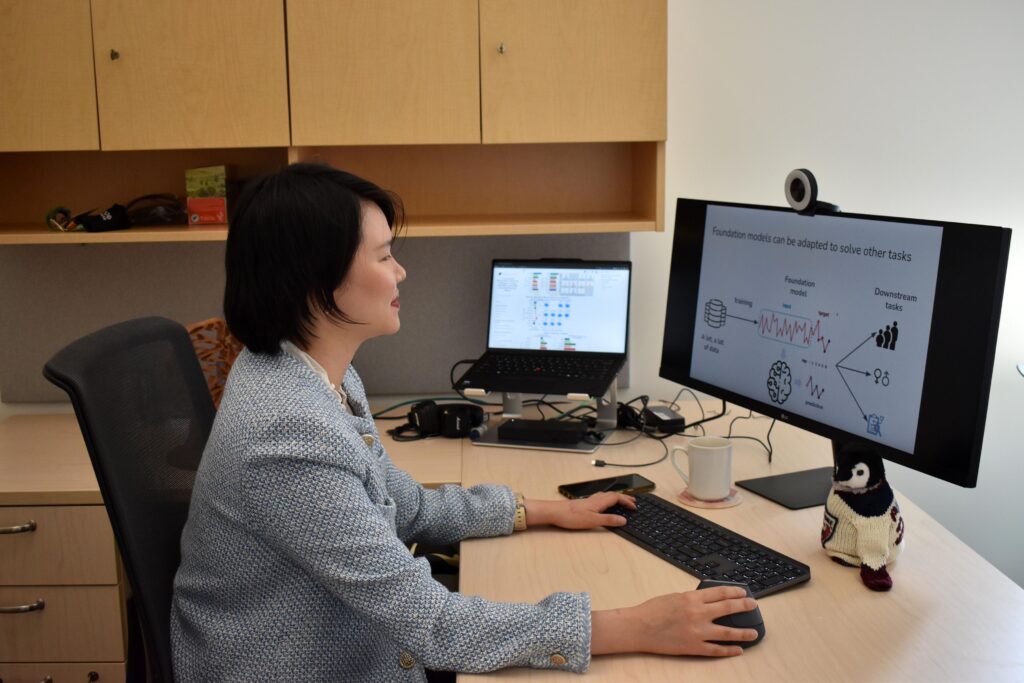
For the Djavad Mowafaghian Centre for Brain Health’s (DMCBH) newest member, Dr. Hao-Ting Wang, the path into neuroscience has been shaped less by a fixed plan and more by curiosity. While studying psychology as an undergraduate, she explored a range of different roles before finding her footing in research.
“I was very open to learning different topics and perspectives, so I tried a lot of different things,” Dr. Wang recalls. “But I realized that I really enjoyed the research element.”
From science fiction to neuroscience
Dr. Wang’s early interest in the brain was shaped as much by storytelling as by science. Growing up, she was drawn to cyberpunk works that explored the boundary between humans and machines, including Ghost in the Shell, Do Androids Dream of Electric Sheep? and Neuromancer.
“There was this idea that we have the capacity to build an artificial brain, but we didn’t know what would emerge until we did,” she says. “I found that a very interesting proposition.”
For Dr. Wang, these works reflect how humanity has evolved alongside scientific advancements. She points to a broader idea in literary studies where fiction, at its core, is a form of introspection.
“I think that science fiction is a way to show how humans understand themselves and interact with changes brought by science,” she notes.
Open science in practice
Dr. Wang’s work is grounded in open science, an approach that emphasizes transparency, collaboration and reproducibility, which aligns closely with the DMCBH’s priorities as an open science institute.
“Science is not just about discovering things. It’s also important to make sure those discoveries are repeatable,” she explains. “Writing your analysis into code is one of the most practical ways to share knowledge.”
She is also a core developer of Nilearn, a widely used open-source Python library for machine learning in neuroimaging. Her work reflects a focus on usability and iteration.
“It’s not about making something perfect,” she says. “It’s about putting something out there that others can use, test and improve.”
A systems view of the brain
Dr. Wang completed her PhD in Cognitive Neuroscience at the University of York, where she developed foundational work on the neural basis of ongoing thought. Her recent research sits at the intersection of cognitive neuroscience, neuroimaging and machine learning, with a focus on brain function in neurodegeneration and mental health. Rather than studying specific brain regions, she views the brain as a dynamic system shaped by real-world interactions.
“The brain doesn’t exist in isolation,” she says. “It’s constantly interacting with the environment, with the body, with everything around us.”
Her work with functional MRI (fMRI) and machine learning aims to bridge brain activity with behaviour. While her research is still in its early stages, Dr. Wang is focused on building reliable, repeatable machine learning frameworks for analyzing fMRI data.
Rather than starting with fixed theories, she tests how well models can predict features like age, sex or disease, then works backward to understand what drives those predictions. In particular, she sees opportunities to collaborate with clinicians to gain new insights on where models fall short.
The role and limits of AI
Dr. Wang draws a distinction between machine learning and what is often referred to as artificial intelligence (AI). She notes that AI is best understood as a type of machine learning framework.
“Traditionally, we try to explain what’s happening in the brain,” she says. “With machine learning, we’re asking: can we reliably predict one thing from another and then understand why?”
This approach enables more systematic evaluation that better reflects the complexity of brain imaging research. At the same time, she emphasizes caution, particularly around the development of AI for neuroscience.
“Brain imaging-based AI is still in its infancy,” she explains. “The tools that are associated with AI right now, like ChatGPT, are what we aspire to create.”
She also highlights the importance of data privacy and ethical awareness.
“If you’re not trained to think about privacy, it’s easy to make mistakes, like accidentally sharing sensitive data,” she cautions. “A lot of AI systems are built on assumptions that everything online is fair to use, which doesn’t always align with human research standards.”
Toward real-world neuroscience
As she begins her new role as Assistant Professor in Data Science in UBC’s Department of Psychiatry, Dr. Wang is particularly excited about naturalistic neuroimaging—an emerging approach that studies brain activity in more realistic settings.
Inspired in part by Dr. Tamara Vanderwal, this research involves analyzing brain data collected while participants watch films, play video games and listen to stories. Her goal is to use this type of data to build better models of the brain.
“I’m interested in models that don’t just reconstruct brain activity, but do so in a way that reflects what someone is actually experiencing,” she says.
This approach is especially important for mental health research.
“When people describe their experiences, they’re talking about their lives in the real world,” she says. “If we don’t study the brain in those contexts, we’re not seeing the full picture.”
Bridging research and impact
Dr. Wang sees her role as a connector between the technical and clinical communities.
“I see myself as someone who can talk to both developers and clinicians,” she says. “And help build tools that bridge those two communities.”
That translational focus reflects a broader motivation behind her work.
“At the end of the day, we want to understand the brain so we can help people,” she emphasizes. “The whole point of research is to have real-world impact.”
Life outside the lab
Outside of her research, Dr. Wang enjoys hands-on, creative hobbies.
“I like making things with my hands,” she says. “Whether that’s writing code, cooking or knitting.”
During her postdoctoral research as a Canadian Neuroanalytics Scholar at Montreal Geriatric University Institute (CRIUGM), she cooked at pop-up events with a chef friend. More recently, she’s taken up knitting and even completed her first sweater this year.
She is also a longtime fan of Olympic weightlifting, having trained for several years. It’s also given her a sense of community with people she wouldn’t normally meet in academia.
“There are actually a lot of knitters on our weightlifting team,” she laughs. “It’s an interesting overlap as they are both very technical hobbies.”
As she joins the DMCBH, Dr. Wang looks forward to exploring new ideas and collaborations, while learning to step back from the technical details to ask bigger questions.
“I’ve spent years focusing on the technical side of things, both in science and in my hobbies,” she says. “Now I’m also asking: what’s the bigger picture?”
It’s a shift that reflects both her journey so far and where she hopes her research can go next.