Congratulations to the Master’s and PhD graduates of the Graduate Program in Neuroscience (GPN), spring class of 2026! 11 trainees are graduating this week and to celebrate, we asked them to share some of their favourite memories during their time at UBC, their future plans and advice for future students.
Minghao Ma, MSc
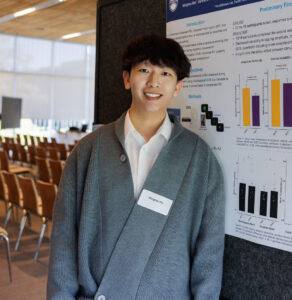 Supervisor: Martin McKeown
Thesis title: Effects of personalized galvanic vestibular stimulation on rhythmic motor control: underlying role of motor vigour in Parkinson’s pathophysiology
Summary of research: Parkinson’s disease can make movements slower and smaller, partly because the brain has difficulty generating enough motivation for movement. My thesis adopted a precision approach by delivering personalized, imperceptible electrical stimulation to the vestibular system and found that it improved finger-tapping size and speed while also helping reduce side-to-side trunk instability during walking. These findings highlight the importance of individualized neuromodulation and suggest that vestibular stimulation may serve as a complementary treatment to help manage motor symptoms of Parkinson’s disease.
What’s a skill you gained during grad school that you’ll carry forward in your future career? Working in a multi-disciplinary lab gave me the opportunity to hear different perspectives and learn how to communicate scientific findings clearly to people with diverse academic backgrounds and research interests.
What is your favourite UBC/GPN memory or something that you’ll miss the most about UBC? I will miss the beautiful UBC campus, amazing facilities and events available year-round, and most importantly, my supervisor, colleagues and peers at the DMCBH, who have supported me in many different ways throughout this journey.
What are your future plans and/or what are you looking forward to after graduation? During my studies, I was fortunate to interact with people with Parkinson’s disease and hear their stories. Moving forward, I hope to continue working in clinical research, and I am excited to contribute to the advancement of novel treatments for people with neurological disorders.
Do you have any advice for future students? Find a research area that really excites and motivates you. Commit to a hobby that can provide instant validation or a sense of reward, which you will often need while doing research.
Behnaz Salek, MSc
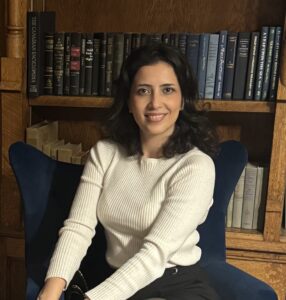
Supervisor: Daniel Goldowitz
Thesis title: Investigating the Cellular Origins of Group 3 Medulloblastoma
Summary of research: My research focused on understanding the developmental origins of Group 3 medulloblastoma (MBG3), the most aggressive subtype of pediatric medulloblastoma. Using single-cell RNA sequencing datasets from mouse cerebellum and human tumors, I identified molecular signatures suggesting that MBG3 likely arises from cerebellar nuclear (CN) neuron progenitors, while Group 4 tumors are more closely associated with unipolar brush cell (UBC) lineages. This work helps improve our understanding of tumor biology and may contribute to better classification and future therapeutic strategies for pediatric brain tumors.
What’s a skill you gained during grad school that you’ll carry forward in your future career? One of the most valuable skills I gained during grad school was learning how to communicate complex scientific ideas to different audiences in a clear and understandable way. Grad school also taught me resilience, adaptability, and problem-solving. Research rarely goes exactly as planned, and I learned how to handle unexpected challenges, troubleshoot experiments and analyses, and stay motivated even when projects became difficult or results were uncertain. Grad school taught me how to think critically, approach problems from multiple perspectives, and continue learning new skills quickly.
What is your favourite UBC/GPN memory or something that you’ll miss the most about UBC? Although I have completed my program, I am fortunate to still be at UBC as a researcher in another lab, so I continue to enjoy the supportive community, collaborative atmosphere, and the beautiful campus. I will definitely miss the GPN community and especially the holiday events, which made the experience at UBC feel very connected and supportive.
What are your future plans and/or what are you looking forward to after graduation? Two months ago, I started working as a Research Assistant at UBC, and I’m really excited to continue growing in this role. I look forward to gaining more hands-on experience in neuroscience research, expanding my technical and laboratory skills, and learning more about lab coordination and management. I am especially interested in strengthening my computational and bioinformatics skills and applying them to translational and clinically relevant research questions.
Do you have any advice for future students? Be open to learning outside your comfort zone and don’t be afraid to ask questions. Grad school can be challenging, but building supportive connections and staying curious makes the experience much more rewarding.
Aysha Allard Brown, PhD
 Supervisor: Brian Kwon

Thesis title: Hemorrhage progression after traumatic spinal cord injury
Summary of research: After a traumatic spinal cord injury, bleeding within the spinal cord indicates severe injury and is linked to poorer recovery. My research investigated how two common early treatments affect spinal cord bleeding during the first week after injury: 1) raising blood pressure to improve spinal cord blood flow, and 2) preventing blood clots. Using ultrasound, MRI, and histology, I developed semi-automated methods to measure bleeding progression within the spinal cord.
What’s a skill you gained during grad school that you’ll carry forward in your future career? Perseverance, which strengthened my confidence in problem-solving.
What is your favourite UBC/GPN memory or something that you’ll miss the most about UBC? One of my favourite experiences was travelling to conferences to present my work, meet new people, and learn from both research and clinical perspectives.
What are your future plans and/or what are you looking forward to after graduation? I’m excited to continue in healthcare, combining patient care and research to improve the lives of people living with spinal cord injuries.
Do you have any advice for future students? Embrace challenges as opportunities to learn and grow.
Fiza Arshad, PhD

Supervisor: Catharine Winstanley
Thesis title: Audiovisual cues and immersion across gambling and basketball: cognitive, behavioural, and physiological perspectives.
Summary of research: My research explores how environmental sights and sounds influence self-reported immersion and interact with physiological and behavioural responses. I also examined how these cues interact with individual traits like gender, ADHD features, and psychological distress to drive focus, helping us better understand how digital designs capture our attention in immersive environments.
What’s a skill you gained during grad school that you’ll carry forward in your future career? I’ve really honed the ability to translate complex behavioural and physiological data into clear, actionable stories. Beyond statistical and programming modeling, it taught me how to work around inevitable research setbacks and build the resilience to bounce back even when the numbers don’t work in your favour. I also learned what to let go of to move forward in my PhD.
What is your favourite UBC/GPN memory or something that you’ll miss the most about UBC? I’ll deeply miss the stunning campus views, the wonderful community at UBC childcare, and the different playgrounds where I’ve loved going for playdates since becoming a mom. Some of my favorite early memories are having dinners with friends and neighbours at UBC residence. I will always miss simply walking around this beautiful campus.
What are your future plans and/or what are you looking forward to after graduation? I’m really looking forward to taking my expertise in advanced data analyses and scientific writing out into the field to tackle new, complex challenges. Most of all, I am incredibly excited to finally stop having to answer the dreaded “when are you done?” questions from well-meaning family and friends!
Do you have any advice for future students? Don’t be afraid to say no and protect your time. It is incredibly important to draw healthy boundaries early on so you can focus entirely on what truly matters to you in both your personal and professional life.
Isabel Bestard, PhD
Supervisor: Weihong Song & Brian MacVicar
Thesis title: Decoding presenilin 1 mutations in Alzheimer’s disease: molecular, cellular, and behavioural signatures
Summary of research: Using in vitro and in vivo models, I studied how presenilin 1 mutations linked to Alzheimer’s disease affect proteins, cell function, and memory. I showed that different mutations converge in specific molecular pathways, while causing distinct cognitive and cellular changes in different brain regions. These findings help guide safer, more targeted treatments for Alzheimer’s disease.
What’s a skill you gained during grad school that you’ll carry forward in your future career? I developed resilience and problem-solving skills. Experiments do not always work as planned, so I learned how to troubleshoot, adapt, and stay persistent in the face of challenges. These are skills I will carry into any future career.
What is your favourite UBC/GPN memory or something that you’ll miss the most about UBC? What I will miss most is the close friends I met during my first year of neuroscience courses, who became an important support system throughout my PhD. A favourite memory was the DMCBH retreat in the Okanagan campus.
What are your future plans and/or what are you looking forward to after graduation? I am excited to see where my next chapter takes me and to continue growing professionally beyond graduate school.
Do you have any advice for future students? Try not to be discouraged by failed experiments, as it is a part of doing science and there is always something to learn, troubleshoot, and improve. Be patient with yourself and lean on your support system. You got this and good luck!
Isabella Gallello, PhD
Supervisor: Jeremy Seamans
Thesis title: Investigating the role of the anterior cingulate cortex in the production of hyperkatifeia during opioid withdrawal
Summary of research: The number of opioid overdose deaths are increasing at a rapid rate and emotional distress during withdrawal is a strong predictor of relapse in individuals with opioid use disorder. This thesis investigates a potential mechanism for producing emotional distress during withdrawal that involves the anterior cingulate cortex, a brain structure involved in the production of emotional pain responses.
What’s a skill you gained during grad school that you’ll carry forward in your future career? How to adapt and problem solve. Not one of my experiments worked as intended the first, or even fifth time. It took a lot of redesigning and creative solutions to get to the end results.
What is your favourite UBC/GPN memory or something that you’ll miss the most about UBC? I am going to miss the members of my lab the most! While we still visit, it will never be the same as the long hours we spent together working on experiments and trying (unsuccessfully) to outsmart the rats.
What are your future plans and/or what are you looking forward to after graduation? I am working as a research associate for Aspect Biosystems, where I get to continue doing the in-vivo work I love. Now that I am finished with school, I am looking forward to learning new things I didn’t have time for including speaking Italian, playing the piano, and running half marathons.
Do you have any advice for future students? Having hobbies outside of graduate school is so important. When experiments fail (and they will) it is helpful to have something that recharges you so that you can come back and solve those problems with a fresh mindset.
Joseph Liang, PhD
Supervisor: Catharine Rankin
Thesis title: Phenomic Characterization of C. elegans Orthologs of Parkinson’s Disease-Associated Genes
Summary of research: Parkinson’s Disease (PD) is the fastest growing nervous system disorder, but its causes remain poorly understood. Recent studies have identified numerous gene regions linked to PD risk, yet scientists face two challenges: 1) too many candidate genes to study using traditional animal models, and 2) difficulty pinpointing the exact causal gene within each region. For my PhD, I used Caenorhabiditis elegans, a simple model organism that shares many genes with humans, to study the functions of PD-linked genes. By analyzing the movements and behaviors of animals where the worm versions of these genes are dysfunctional, I measured over 100 traits across 173 different genetic strains using machine vision. The data revealed common movement impairments and were used to train a machine learning model that can identify likely causal genes at unresolved risk regions. This work accelerates PD gene discovery and expands our understanding on the involvement of genetics in PD.
What’s a skill you gained during grad school that you’ll carry forward in your future career? The most important skill I learned is to always look for opportunities to learn something new (and in grad school you will have no shortage of these opportunities). Learn to be an expert at learning!
What is your favourite UBC/GPN memory or something that you’ll miss the most about UBC? Playing intramural basketball and soccer with other members of the GPN. I’ll miss having a connection with peers who went through the same journey I did, and getting advice and perspective from seniors who are just a few milestones ahead of you.
What are your future plans and/or what are you looking forward to after graduation? Take a deep breath (celebrate), catch up with family and friends, and a few other things that I have put off during my PhD.
Do you have any advice for future students? Keep reminding yourself that you are human, and be patient with yourself. Humans have human problems and make mistakes. Remember to give yourself some grace while on this journey! You’ll make it!
Rocio White, PhD
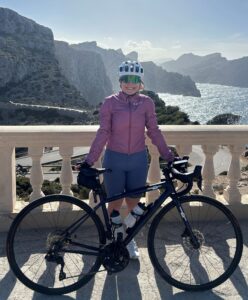
Supervisor: Shernaz Bamji
Thesis title: ZDHHC9 and its roles in oligodendrocyte maturation, function, and neuronal development
Summary of research: My thesis focused on a gene, ZDHHC9, disrupted in many patients with intellectual disability. I showed that ZDHHC9 guides the growth and insulation of connections between brain cells, and that its loss disrupts these processes.
What is your favourite UBC/GPN memory or something that you’ll miss the most about UBC? I will most miss the beautiful campus and friends I made at UBC. In particular, I will miss being a part of the triathlon team. One of my favourite UBC memories was storming the wall with them every spring, it’s a uniquely UBC experience!
What are your future plans and/or what are you looking forward to after graduation? I have started my Postdoctoral fellowship at Imperial College in Ed Tate’s laboratory where I will continue studying S-acylating ZDHHC enzymes but in the context of cancer with the aimto develop cancer therapeutics.
Do you have any advice for future students? My advice to future students is to enjoy grad school as much as possible. It’s a great time to explore and broaden your scientific interests and it goes by really quick.
Ryan McCallum, MSc
Supervisor: Mahmoud Pouladi
Thesis title: A novel GPM6A point mutation in a patient with autism spectrum disorder and intellectual disability alters neuronal development within hiPSC-derived neurons and organoids
Jiake Wu, MSc
Supervisor: Tony Traboulsee
Thesis title: Spinal cord tract-specific myelin water fraction and heterogeneity indices predict five-year disease progression in multiple sclerosis
Poljanka Johnson, PhD
Supervisor: Shannon Kolind & Tony Traboulsee
Thesis title: Investigating biomarkers of clinical progression in multiple sclerosis using magnetic resonance imaging, blood biomarkers, and machine learning