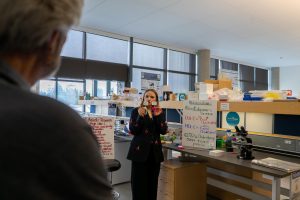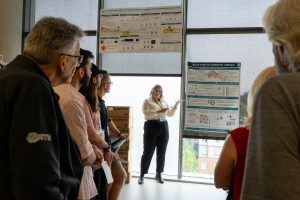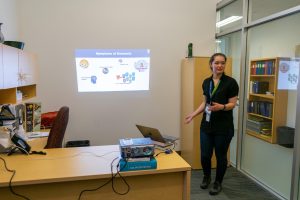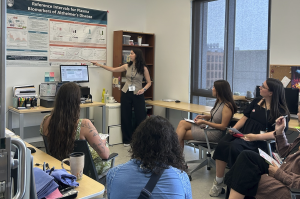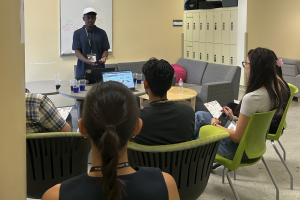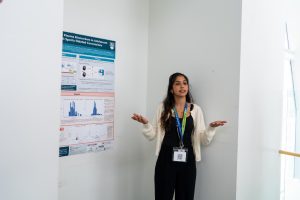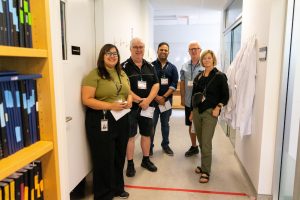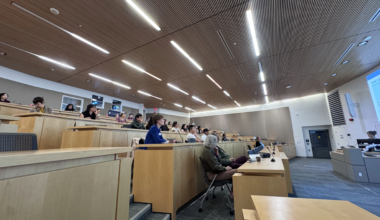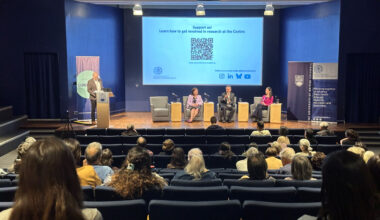
On Saturday, September 6th, the Wellington Lab hosted its first-ever Friends and Family Open House at the Djavad Mowafaghian Centre for Brain Health. This graduate student-led initiative was focused on providing trainees with an opportunity to practice their knowledge dissemination skills to a general audience in a relaxed and low-stress environment. Lab members were encouraged to invite their friends and family, with an emphasis on bringing people who did not work in science or academia. The event attracted 68 participants, which is a true testament to the strong support network that the lab has.
After an introduction from the event chairs and Dr. Cheryl Wellington, participants rotated through eight interactive stations where trainees gave short, lay-friendly presentations about their projects:
- Jennifer Cooper presented Blood Tests For Alzheimer’s Disease, providing an overview of what biomarkers we can measure in blood to detect Alzheimer’s disease and how blood tests are developed.
- Tetiana Poliakova presented Humanizing Mice to Study Alzheimer’s Disease, introducing how we create mouse models with human-like cholesterol profiles to explore how cardiovascular risk factors drive Alzheimer’s disease.
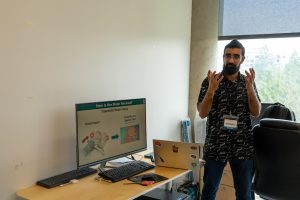
- Mohammad Ghodsi presented Brain Injury is a Complicated Mess, talking about the different causes of brain injuries, including their complex biological mechanisms and clinical implications.
- Kidus Achalu presented Biomarkers and Sports-related Concussions, explaining how we discover and develop new blood tests for concussions, with an emphasis on the detection of injuries that are tough to detect clinically.
- Isabella DiBerardino presented How Do We Make Reference Intervals, And How Can They Help Us, walking through the methods we use to develop reference intervals for blood tests, which are used to tell us if a test result is normal or abnormal.
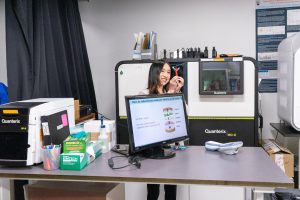
- Dana Go presented Sandwiches in Biomarker Lab Tests, providing an overview of all the analyzers we use for blood biomarker research and how the underlying technology works, including the Abbott iStat, Quanteric HD-X and Alamar ARGO HT.
- Rachael Smith presented Dementia – One Name, Many Conditions, explaining different types of dementia, including Alzheimer’s disease, frontotemporal dementia and vascular dementia, discussing their causes and clinical symptoms.
- Simren Ahuja presented Paired Biomarkers for Improving Concussion Diagnosis, showcasing a project that looks at how using a single person’s baseline and post-concussion sample can improve our ability to find new blood biomarkers for concussions.
Participants were eager to learn, asked thoughtful questions and enthusiastically joined in activities like BINGO, for a chance to win prizes donated by the lab’s sponsors. The event concluded with a reception where attendees shared how much they enjoyed the day and expressed excitement about future opportunities to engage with science in this way.
This event was made possible thanks to the hard work of event co-chairs Jennifer Cooper and Tetiana Poliakova, with invaluable support from the organizing committee: Mohammad Ghodsi, Kidus Achalu, Dana Go, Isabella DiBerardino and Rachael Smith. Thanks to the event sponsors Alamar Biosciences and Quanterix, as well as the prize donors, including the UBC Pathology Department, Djavad Mowafaghian Centre for Brain Health, Vancouver Coastal Health Research Institute, UBC Graduate Student Society and the Alzheimer’s Society of BC, whose generosity helped make the event a true success.