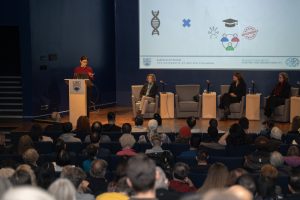
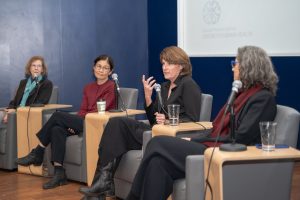
On November 3, 2025, more than 240 guests gathered at UBC Robson Square for Rewiring the Mind: How Science, Lifestyle and Wellness Shape Brain Health, an evening that explored how science, lifestyle and wellness intersect to shape brain health. Presented by UBC Connects at Robson Square in partnership with the Djavad Mowafaghian Centre for Brain Health, the UBC Faculty of Medicine and UBC Community Engagement, the event brought together three leading neuroscientists — Dr. Lara Boyd, Dr. Silke Appel-Cresswell and Dr. Teresa Liu-Ambrose — to share how our brains adapt, learn and thrive throughout life.
This was the first event in a three-part series co-hosted by UBC Connects and the Centre for Brain Health, inviting the public to engage with cutting-edge research and practical strategies for lifelong brain wellness.
The brain’s incredible capacity for change
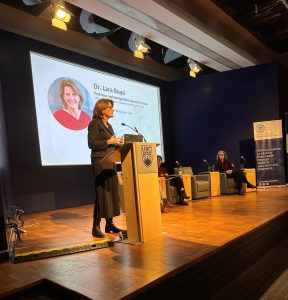 The evening opened with Dr. Lara Boyd, UBC Distinguished University Scholar and former Canada Research Chair in Neurobiology of Motor Learning and Rehabilitation. Her talk showcased the brain’s remarkable ability to rewire itself through learning and experience. Using vivid metaphors — neurons as “billions of beautiful trees” communicating through chemical sparks — Dr. Boyd explained that “your brain changes chemically, structurally and functionally every time you learn something new.” She highlighted how practice, sleep and repetition transform fleeting moments of memory into lasting knowledge.
Dr. Boyd also described how her Brain Behaviour Lab is translating this science into stroke recovery research, using brain stimulation, high-intensity exercise and video games to help patients retrain movement and cognition. She also emphasized that a one-size-fits-all approach to brain wellness and recovery cannot work since every brain is unique and every person’s path to learning and healing is too.
“Each of us has an incredibly unique brain that’s absolutely shaped by our past experience, our behaviour, our motivation,” she noted. “And that brain is going to respond uniquely.”
“I hope I’ve convinced you that your brain is amazing. When you leave this room tonight, your brain will not be the same as when you entered.”
— Dr. Lara Boyd
Eat, play, love — and sleep
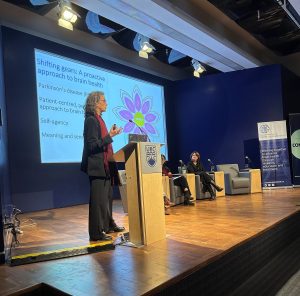
Next, Dr. Silke Appel-Cresswell, neurologist and co-founder of the BC Brain Wellness Program, invited the audience to imagine wellness as something both scientific and soulful. She spoke playfully about how important it is to eat, play, love — and sleep.
Drawing from her research on Parkinson’s disease and healthy aging, Dr. Appel-Cresswell described how Mediterranean-style diets, regular movement, creative pursuits and strong social ties protect brain health and may even extend lifespan. She also addressed the growing epidemic of loneliness, urging attendees to view social connection as essential — and evidence-based — nourishment for the brain.
The story of the BC Brain Wellness Program, which Dr. Appel-Cresswell helped launch in 2019, has reached thousands through classes in exercise, nutrition, mindfulness and the arts. It is an inspiring example of how comprehensive programming can engage all aspects of brain health.
“It’s important to really do these things together,” she noted. “Because it’s the combination of these things that are so much more powerful than just one of them on their own.”
“We asked participants to give us six words that they associate with brain wellness, and the word that came out the biggest was community. Regardless of what people did, this is really what we’re creating. And that really speaks to the meaning of community.”
— Dr. Silke Appel-Cresswell
Moving toward resilience
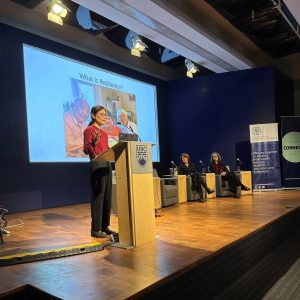
Closing the presentations, Dr. Teresa Liu-Ambrose, Tier 1 Canada Research Chair in Healthy Aging and UBC lead of the Canadian Longitudinal Study on Aging, explored how movement strengthens both the body and the brain. Her message was simple yet profound: movement is medicine.
Sharing stories from her research and her own family, Dr. Liu-Ambrose illustrated how even short daily walks can preserve memory, strengthen resilience and reverse brain age by up to two years. She reminded the audience that resilience is “shaped by how we live and the environment we immerse ourselves in every day.”
Her warmth and humour, paired with practical advice, drew smiles throughout the theatre. She left attendees with an empowering message: brain health doesn’t require perfection or marathon workouts, just small, consistent acts of movement and care.
“Your brain literally will change as you exercise, and the next bout is going to be easier and easier. You just have to start… When you exercise, you release dopamine, which allows you to feel more motivated. It’s a cyclic pattern of behaviour.”
— Dr. Teresa Liu-Ambrose
From curiosity to connection: a community in conversation
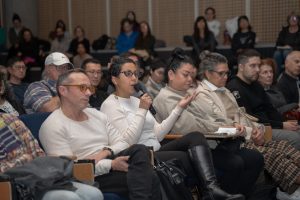
During the Q&A session, hands quickly filled the air as guests posed thoughtful questions about stroke recovery, Parkinson’s disease, diet, exercise and gender differences in brain health research. Audience members also explored the effects of new technology, mindfulness and social connection on the brain — continuing the evening’s central theme: that the mind is not fixed, but a living system shaped by how we move, learn, eat and connect.
At the Djavad Mowafaghian Centre for Brain Health, we’re advancing the science that makes these discoveries possible — from understanding how the brain changes to developing new ways to protect and restore it. You can be part of this progress by getting involved in research studies, attending future events, or supporting innovation in brain health. Together, we can turn research into real-world impact for all Canadians.
Watch a recording of the event on our YouTube channel:


