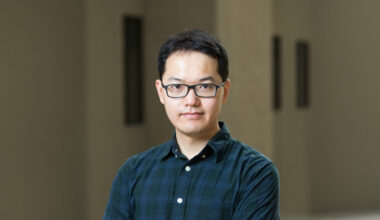
Growing up in a small town in Ontario, Dr. Milan Valyear always enjoyed tinkering and building things, and in particular, one memory stands out.
“It was the summer, school was out, and so was the power – 3500 megawatts had surged from New York to Ontario,” he recalls. In the dark, he built a rudimentary flashlight, complete with a dimmer switch, along with many far less useful gadgets. What mattered to him wasn’t the end result, but the process.
“While it was unclear when the power would return, I was comfortable with the uncertainty. Tinkering brought me closer to solving immediate problems and understanding why 3500 megawatts was too many megawatts, for example,” Dr. Valyear explains. “So growing up, I didn’t know what I wanted to be, but I knew what I wanted to do. I wanted to understand things and I wanted to tinker.”
Today, as a new Assistant Professor in UBC’s Department of Psychology and a researcher at the Djavad Mowafaghian Centre for Brain Health (DMCBH), that same curiosity continues to shape his approach to neuroscience.
From curiosity to brain circuits
Dr. Valyear’s path into science was driven less by a fixed goal and more by a desire to explore unanswered questions.
“It seemed like so little was known, relative to other disciplines, and that new techniques were required to learn more,” he says.
Throughout his training, he gravitated toward emerging tools that could push the boundaries of what researchers could observe and manipulate in the brain. As a graduate student, he established a breeding colony of transgenic rats and used chemogenetic tools to study neural circuits. Later, as a postdoctoral fellow, he adopted optical methods to both record and control neural activity across scales, from individual neurons to entire brain regions.
“New techniques empower us to resolve old questions and ask new questions,” he notes. “I wanted to be at the forefront of these efforts.”
Understanding why we act and when we stop
At the core of Dr. Valyear’s research are two fundamental processes: reinforcement and disengagement. To explain them, he turns to a familiar experience.
“Imagine the buzz of a coffee grinder, espresso gushing into a warm mug, and steam whirling milk into a smooth foam,” he says. “The irresistible pull towards a cappuccino arises because consuming a cappuccino reinforces approach – this is a Pavlovian learning process.”
But what happens after that first sip is just as important.
“If the cappuccino is too hot, one might enjoy brief sips, readily disengaging their consummatory behaviour, but if the urge to consume is so intense, long bouts of drinking may occur.”
His lab studies the brain processes that drive both the urge to act and the ability to stop—mechanisms that, when disrupted, can contribute to conditions such as addiction, alcohol use disorder and binge eating.
“Our hope is that understanding these processes will allow us to normalize behaviours that are rendered pathological because they are disproportionately reinforced or ineffectively disengaged.”
The power of simple questions
Dr. Valyear traces his fascination with behaviour back to a simple undergraduate experiment.
Two groups of rats were given access to a sugar solution—one daily, the other every third day. Despite having constant access to food and water, the second group consumed dramatically more when the sugar returned.
“I remember entering the animal housing room and looking at the bottles on all the cages imagining their fill lines as bar graphs,” he says. “I was amazed that such a simple manipulation could produce such a clear change in behaviour and tell us something so interesting about the brain.”
That moment crystallized something essential: even straightforward experiments can reveal powerful insights into how the brain works.
Mentorship and discovery
In his lab, Dr. Valyear brings that same spirit of curiosity and experimentation to mentorship.
“In my lab, we aim to sculpt big questions into clear and incisive experiments,” he explains. “Often, this involves tinkering our way into new technical or analytical approaches difficult to envision at the outset.”
What he finds most rewarding is watching that process unfold in others.
“It is fulfilling to watch someone bridge the gap between question and experiment,” he says. “There is a slow realization that you can do something unique and technical, which transitions to a sudden realization that you have discovered something important.”
His advice to students reflects his own path, one shaped by pursuing new interests rather than a fixed plan.
“My advice is to keep an open mind,” Dr. Valyear says. “You never know when a particular course, or professor, or paper might introduce a topic that captures your interest.”
This process of developing and pursuing an interest was repeated and refined across each stage of his career, leading him from biology into psychology, and eventually into neuroscience.
A new chapter on the West Coast
After his childhood in Ontario, Dr. Valyear spent formative years in Montréal before making his way to Vancouver.
“I got into refurbishing old espresso machines, riding and fixing old bikes, and hunting down obscure recordings of live music,” he says. “Now living in Vancouver, these interests have taken on a new feel. The coffee is outstanding, the weather is a lot friendlier to old bikes, and the music scene is superb.”
Outside the lab, he’s been exploring the city’s natural and cultural landscape, from walking through Pacific Spirit Park to snowshoeing on Cypress Mountain and discovering Vancouver’s food scene.
“All these new adventures are exciting,” he says. “But of course, I still like to drink coffee, ride bicycles and listen to music.”
At the DMCBH, Dr. Valyear is continuing what he started while he was growing up—asking questions, building tools and following curiosity wherever it leads. Only now, the systems he’s trying to understand are far more complex and the potential impact far greater.