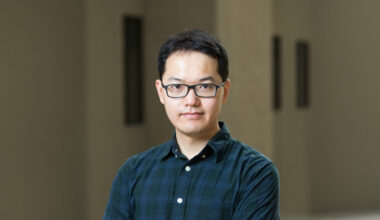
When Dr. Zach Pennington was growing up, he never imagined he would become a scientist.
“I wanted to be a professional skateboarder, a guitarist in a punk band, a poet, an architect,” he recalls. “The cool thing is that I still love all of those things and feel they complement my science.”
As he joins UBC as an Assistant Professor in the Department of Psychology and researcher at the Djavad Mowafaghian Centre for Brain Health (DMCBH), that creative spirit is still evident, from building tools in the lab to finding the campus skatepark between experiments.
From clinical psychology to neural circuits
As an undergraduate studying psychology, Dr. Pennington initially planned to become a clinical psychologist. Everything changed during his junior year, when he took a behavioural neuroscience course.
“Not only did I find the subject fascinating,” he notes. “I was struck by the promise neuroscience had for helping people.”
He joined a lab soon after and was hooked.
“I loved the excitement of designing new experiments, the heated discussions about theories and data interpretation, building things and tinkering in the lab, the slow and methodical processes and of course, the people!”
That blend of intellectual intensity, collaboration and hands-on problem-solving continues to define his research career.
Understanding stress, emotion and the brain
Dr. Pennington’s research focuses on the neural circuits that regulate stress and emotion, and how these circuits are shaped by experience to influence conditions such as post-traumatic stress disorder (PTSD).
His lab uses a range of tools and techniques to record neural activity from populations of brain cells in freely behaving mice (using miniature microscopes called miniscopes) and manipulate neural circuits to test their function (using optogenetics).
“Right now, I’m super excited about exploring how hypothalamic cell types – as well as neural synchrony between the hypothalamus and other brain regions – regulate stress responses.”
Ultimately, Dr. Pennington’s work aims to uncover biological mechanisms that may inform better treatments for mental health challenges.
Open science and DIY innovation
One of Dr. Pennington’s core philosophies is a commitment to open-source science, which aligns perfectly with the DMCBH’s priorities as an open science institute.
Frustrated by the high cost of commercial equipment and proprietary software, he thought, “Can I just build it myself?”
His interest in DIY punk rock, where bands produce and distribute their own work, resonated deeply with the idea of accessible science.
“When I saw that mindset in science,” he says, “I thought, I want to be part of that.”
That philosophy led him to create ezTrack, a free, open-source behavioural tracking software platform now used across six continents. The response, he says, was overwhelming.
“It showed that you can increase equity in science by making it accessible for all.”
The importance of continuous learning and collaboration
For Dr. Pennington, one of the greatest joys of being a scientist is the variety.
“I love how dynamic being a scientist is. In a single day, I can go from mentoring a student, to running an experiment, to analyzing data, to writing a manuscript,” he says. “I get to fulfill so many different passions and constantly learn new things.”
That collaborative energy also shapes how he is building his team.
“It’s not about having the perfect resume,” he emphasizes. “Graduate students are going to learn a lot from scratch. What matters most is being excited about that learning process.”
The qualities he looks for are passion, initiative and a desire to collaborate.
“Wanting to be on a team and liking to work with other people, that’s what’s most important.”
Life in Vancouver
Outside the lab, Dr. Pennington is embracing life on the West Coast.
“Vancouver has two of my very favourite things: amazing food and nature,” he laughs.
Outside of the lab, he enjoys hiking, biking and skateboarding, seeing art, exploring the city’s food scene and spending time with his wife, Saritha, and their two cats.
For someone who once imagined a future in punk bands and skateparks, neuroscience may not have been the original plan, but the creative energy, hands-on building and collaborative spirit remain central to his work.
And at the DMCBH, that spirit is now shaping a new generation of neuroscientists, and new insights into how the brain responds to stress.