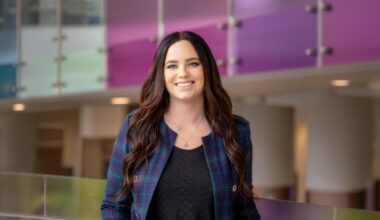
For Dr. Stefanie Blain-Moraes, joining the Djavad Mowafaghian Centre for Brain Health (DMCBH) is the next step in a career devoted to bridging engineering, neuroscience and rehabilitation, in pursuit of one profound question: What does it mean to be conscious?
As a new UBC faculty member jointly appointed as an Associate Professor in the School of Biomedical Engineering (SBME) and the Department of Occupational Science & Occupational Therapy, her research aims to develop tools to understand and communicate with people who are minimally communicative after brain injury or illness.
“We’re trying to answer one of the most fundamental questions in the world of consciousness,” she says. “Is there someone who’s in there that we can communicate with?”
From engineering to neuroscience
“During my undergrad, I fell in love with the idea of rehabilitation engineering very quickly when I worked in a pediatric rehabilitation hospital with a biomedical engineer,” she recalls.
Dr. Blain-Moraes earned her bachelor’s degree in engineering science at the University of Toronto, then completed a joint PhD degree in biomedical engineering and rehabilitation sciences—a combination that gave her a unique perspective on both the technical and clinical sides of things.
“I loved the idea of building technologies that could make a difference in people’s lives,” she notes. “Engineering allowed me to innovate, create and design, but I also saw what the clinical reality looked like.”
It wasn’t until her two postdoctoral fellowships at the University of Michigan that her focus shifted towards neuroscience. Working with minimally communicative individuals, she saw the limits of technology that measured only peripheral signals.
“I thought, we have to go to the source—the brain,” she explains. “That led me to working with brain-computer interfaces and eventually to the neuroscience of consciousness.”
Exploring consciousness and personhood
Prior to coming to UBC, Dr. Blain-Moraes held a Canada Research Chair in Consciousness and Personhood Technology at McGill University, where she built a pioneering research program exploring what it means to be aware and perceived as a person when communication is limited.
“Consciousness and personhood are usually treated as separate domains — one scientific, one philosophical,” she says. “But having them together and being able to talk about the subjective experience of people who don’t have typical ways of interacting with the world, that opened up a huge space for my lab to grow.”
Her Biosignal Interaction and Personhood Technology (BIAPT) Lab became a highly interdisciplinary space, bringing together engineers, philosophers, artists, anthropologists and social scientists to study the brains and bodies of minimally communicative individuals and how that shapes the way others perceive them.
Research influenced by music and volunteering
Growing up, Dr. Blain-Moraes loved both science and music. She plays piano and flute, and once debated whether to pursue engineering or music as a career.
“In the end, I made the very pragmatic choice of engineering as my degree and music as my hobby,” she laughs. “But both have stayed with me.”
That blend of art and science is visible in her lab’s Biomusic project, which translates changes in physiological signals into musical output. This technology has been shown to support a sense of presence and personhood of persons with diverse communicative capacities by enabling others to “tune in” to meaningful changes in an individual’s physiological state.
Another major influence on her research was her volunteer experience in a pediatric rehabilitation hospital’s complex continuing care unit.
“Those five years of volunteering were really formative for me,” she recalls. “Seeing the relationship between these children and their parents who showed up every day, even though they didn’t get acknowledged — that human element of love and care had a profound impact on what I chose to study and the kind of research that I wanted to pursue.”
Building connections in Vancouver
As she establishes her lab at the DMCBH, Dr. Blain-Moraes is working on connecting with local clinical and artistic communities.
“One of the driving philosophies behind the questions that we ask in the lab is that they need to be grounded in the needs of our clinical partners,” she explains. “Across Canada, the local context changes and varies at each hospital — it depends on what expertise is available, where you go to get care and the culture of practice.”
She has already begun engaging with Vancouver’s arts and wellness communities, including the BC Brain Wellness Program, therapeutic clowns and local dance and music groups.
“There is incredible artistic talent in Vancouver,” she says. “I’m excited to explore how these creative practices can interact with our research.”
Through her joint appointment with SBME, Dr. Blain-Moraes is also partnering with the Neil Squire Society’s “Makers Making Change” initiative. Their first collaboration was the Hacking for the Holidays event in December, which invited engineering students to adapt toys for children with limited motor skills.
From the ICU to the bedside
Clinically, her lab continues to study how to better assess consciousness in patients with severe brain injury.
“If someone in the ICU isn’t responding to your tests, it’s incredibly difficult to know their prognosis,” she explains. “Are they going to recover consciousness? And if so, how much is their cognitive function going to recover?”
Her team developed the Adaptive Reconfiguration Index, a “stress test” that uses high-density EEG and anesthesia to predict long-term recovery.
“The results of the initial study have been very promising,” she says. “Our next goal is to translate this into a bedside tool—paring it down to a simple four-electrode system that could give clinicians insight into what the capacity for recovery is.”
The joys of teaching and mentorship
While she describes herself as a researcher at heart, Dr. Blain-Moraes finds deep joy in teaching.
“Teaching is like photosynthesis,” she explains. “You’re standing in front of the room with nothing more substantial than ideas, like air and light, and by the end of the class, if you’ve done it well, you’ve converted it into energy and something that has actual matter to it.”
Although she enjoys the thrill of research discoveries, mentorship of her graduate students is where she feels the work is most alive.
“There’s this apprenticeship that happens where your mind meets theirs on a very intimate level,” she describes. “I picture it like two swords crossing. When I’m in a deep discussion with one of my students, I can almost see two épées rubbing against each other, both growing sharper. It’s this mind-on-mind connection where you’re shaping each other.”
Looking ahead
As she settles in Vancouver with her husband and three young children, Dr. Blain-Moraes has been embracing the West Coast lifestyle, from biking through Pacific Spirit Park to exploring local beaches.
“It’s amazing,” she says. “You can be in the lab one minute and have your feet in the ocean 15 minutes later.”
In terms of her research, DMCBH represents the perfect convergence of science and care.
“The integration of researchers and clinicians under one roof reminds me of why I started this work,” she says. “It’s an incredible opportunity to keep exploring these big questions about consciousness and what it means to be human.”