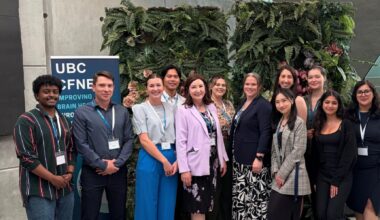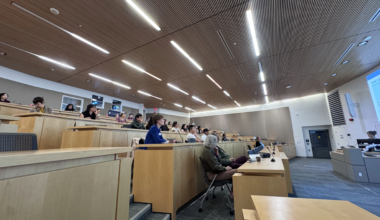
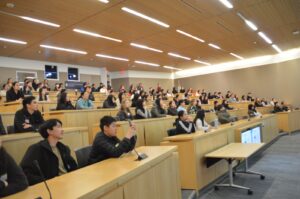
On Saturday, March 28th, 97 high school students gathered at the Djavad Mowafaghian Centre for Brain Health (DMCBH) for the 18th annual Vancouver Brain Bee—marking the largest turnout in the event’s history. The event brought together students from across the Lower Mainland for a full day of curiosity, competition and discovery in neuroscience.
Inspired by the Spelling Bee, the Brain Bee challenges students in Grades 9 to 12 to test their knowledge of the brain and nervous system, from structure and function to neural communication and the biological basis of behaviour, learning and memory. Part of an international initiative spanning more than 30 countries, the Brain Bee connects students through local, national and global competitions.
In Vancouver, the event is sponsored by the DMCBH, UBC’s Graduate and Undergraduate Programs in Neuroscience, the UBC Life Sciences Institute, and the Canadian Institutes of Health Research, with additional prize support from the Vancouver Coastal Health Research Institute (VCHRI).
Participants were also supported in their preparation with a UBC student-led initiative called NeuroCircles. These weekly Zoom sessions connected high school students with UBC neuroscience graduate students, offering opportunities to deepen their understanding of key concepts and build confidence in the weeks leading up to the competition.
A day of discovery and competition
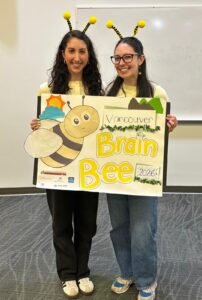
Co-hosts Isabella DiBerardino and Brittany Jensen
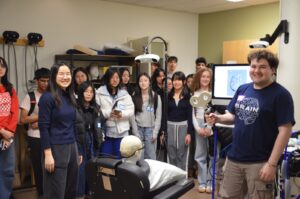
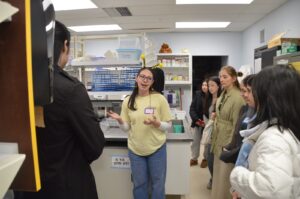
Co-hosted by Neuroscience Master’s student Isabella DiBerardino and PhD student Brittany Jensen, the day opened with welcoming remarks from Dr. Thiviya Selvanathan in the Rudy North Lecture Theatre. The program featured a written exam, guided tours of research labs, a lunch break, and interactive activities that encouraged connection among participants.
For many students, the lab tours were the highlight, including this year’s first-place winner, Grace Guo.
“From advanced machinery and brain scans to digital software and mouse brains, it felt like seeing my textbook pages come to life,” she said. “The lab tours also helped me better understand how neuroscience is applied in real research settings.”
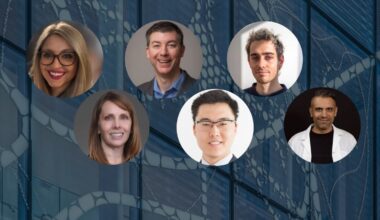
The day concluded with a Jeopardy-style final round, where the top five finalists took the stage. Answering questions posed by judges Dr. Timothy O’Connor and Master’s student Jacqueline Palik from Dr. Erik Pioro’s lab, students demonstrated both deep knowledge and composure under pressure as the audience followed along in anticipation.
The 2026 winners were:
- Grace Guo (1st place)
- Pramith Bhandari (2nd place)
- Angie Lee (3rd place)
- Justin Zhang (4th place)
- Tianyang Hu (5th place)
A personal connection to neuroscience
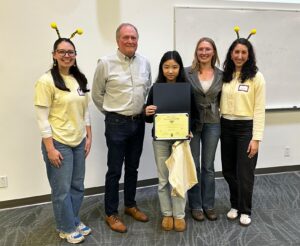
1st place winner Grace Guo
For Grace, the win reflects both dedication and a deeply personal connection to neuroscience.
“This was my second year participating in the Brain Bee, and both experiences have been very eye-opening,” she said. “Preparing for the competition was a lot of hard work, but being able to make it to the oral round and achieve first place was incredibly rewarding and motivating.”
Her interest in neuroscience stems from her own journey with mental health.
“There were moments where I struggled to understand what I was feeling or why my thoughts would shift in certain ways,” she shared. “That made me curious about how the brain works at a biological level.”
Through studying the brain, Grace says she’s gained a newfound self-awareness. She finds that “neuroscience connects personal experience with scientific explanation,” and that connection is what motivates her to keep learning.
“I am someone who is excited by the unknown,” Grace explains. “Neuroscience is one of those vastly fascinating fields where it seems that there is already so much known, but the more you explore it, the more you realize how many questions are still unanswered about how the billions of neurons generate consciousness, memory and behaviour.”
Inspiring the next generation of scientists
“I’ve always been passionate about academic outreach, so the opportunity to help lead the Vancouver Brain Bee was particularly meaningful,” says Isabella, on co-hosting the event. “It gave me the chance to connect with students who share a passion for neuroscience and to introduce others to the field earlier than many have the chance to during high school.”
For Grace, she hopes to one day become a pediatric psychiatrist.
“I want to support children who may be experiencing challenges similar to what I went through,” she said. “I am also inspired by the people who supported me during difficult moments.”
Her preparation and studying for the Brain Bee have already helped shape that path.
“I found myself particularly interested in reading about psychiatric disorders, because they emerge from complex interactions between genetics, brain chemistry, environment and development,” she says. “I hope to learn more about the underlying mechanisms as well as potential future treatments.”
The Vancouver Brain Bee continues to cultivate curiosity and enthusiasm for neuroscience, welcoming students of all backgrounds and levels of experience as they explore potential paths in science and medicine. Congratulations to all participants, and especially this year’s finalists, for their outstanding achievements.
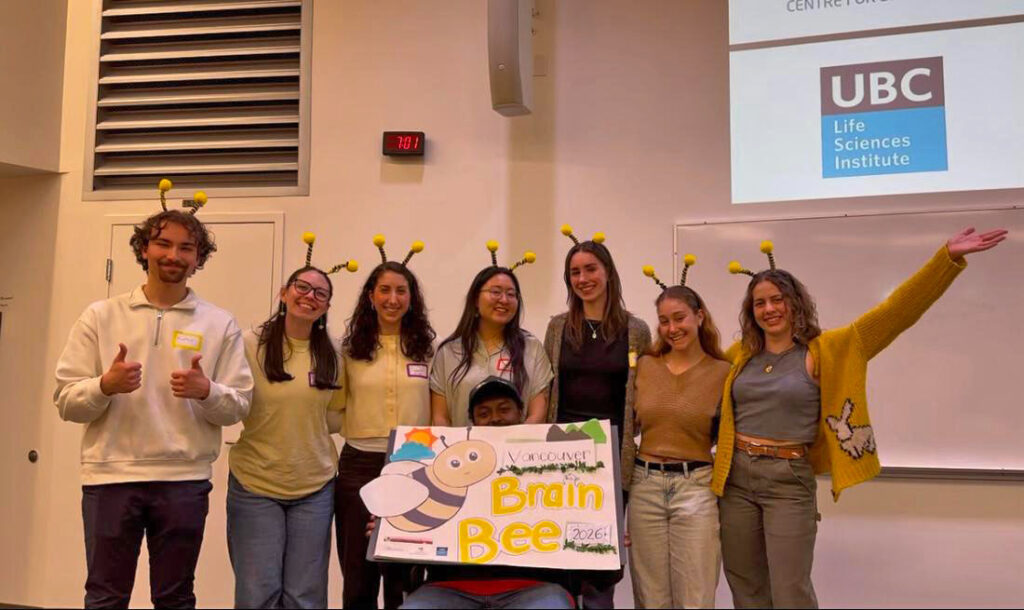
Thanks to the organizing committee who helped make this event possible!