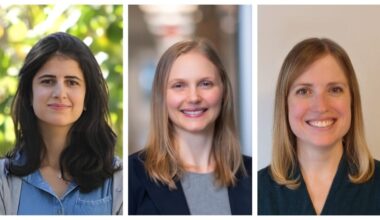
The DMCBH celebrates the International Day of Women and Girls in Science by highlighting the diverse career paths of women in STEM.
What sparked your love for science? A childhood curiosity, a great teacher, or a moment of discovery? On February 11, we celebrate the stories of women who turned their passion into a career, inspiring the next generation to do the same. Learn more about the stories of these DMCBH trainees:
Michelle Jung
PhD Student, Soma Lab
 Michelle Jung’s interest in neuroscience began in an undergraduate behavioural neuroendocrinology course.
“I was fascinated by how the nervous and endocrine systems interact during development and wanted to learn more about it,” she recalls.
Now, as a PhD student in Dr. Kiran Soma’s lab, Michelle is investigating how maternal sucrose (table sugar) consumption affects the offspring’s hormones, brain and behaviour.
“I love that my work allows me to study maternal and offspring health, which aligns with my research interest in neurodevelopment,” she says. “I am also excited by the process of asking a question we don’t yet have answers to and designing experiments to explore them.”
Beyond the research itself, Michelle values the collaborative nature of science. Her work brings together scientists with diverse perspectives and expertise, including professors, postdoctoral fellows, graduate students and undergraduate research assistants. Mentoring undergraduate students has been one of the most rewarding aspects of her experience, and she credits her own mentors for encouraging her curiosity and giving her the confidence to continue her scientific journey.
To girls and women in science, Michelle gives three pieces of advice:
“1. Science is a team effort and your voice is needed! Find people who value your ideas and support your growth.
2. Celebrate the wins, even the small ones. Don’t underestimate your achievements – you earned them!
3. Be open to trying new things. Exploring different paths is one of the best ways to discover what excites you and what doesn’t. If I didn’t take that behavioural neuroendocrinology course – a class that I almost didn’t sign up for – I might have never found my passion for neuroscience.”
Afsoon Mombeini
PhD Student, NC4 Lab
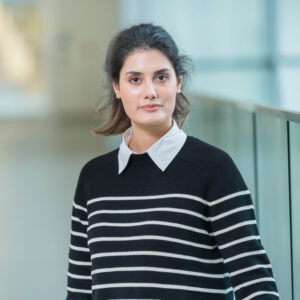 Late in her undergraduate degree in mechanical engineering, Afsoon Mombeini realized that the analytical tools she had been learning could be used to study something far more complex than machines: the human brain.
“I became particularly fascinated by the idea of studying the brain as a dynamical system,” she says. “I have always found the brain to be one of the most incredible systems known, and I believe that understanding the brain is key to understanding ourselves, as much of who we are is shaped by it.”
That realization led her to transition into neuroscience research. Today, she applies her engineering training to study cognitive processes and better understand how the brain gives rise to behaviour and thought.
Afsoon credits many remarkable women and men for inspiring her throughout her life. Drawn to science from a young age, she was especially inspired by a book about Marie Curie that her mother gave her. Another inspiration came during her teenage years, when she watched NCIS and admired the character Abby – a fun, intelligent and confident scientist she aspired to be like.
“I love spending time reading scientific papers and thinking deeply about research ideas, as well as designing experiments,” Afsoon says. “The process of identifying a problem and developing creative ways to investigate it is particularly fascinating to me.”
As a PhD student in Dr. Manu Madhav’s lab, she also values attending talks and conferences, where she can connect with other scientists and learn from their work. Just as important to her is being part of a collaborative research environment and working closely with her labmates.
When asked what advice she would give to women and girls in science, Afsoon’s message is clear:
“Keep going and believe in yourself — you absolutely belong in science. Do not let anyone make you feel that you are not capable or not enough. Be confident, speak up, and trust your curiosity. Science grows stronger when diverse voices and perspectives are included, and your contributions matter.”