This past summer, the SBME Synergy Undergraduate Summer Research Program provided research opportunities for students interested in a career in biomedical engineering. We caught up with five students who worked in DMCBH members’ labs to learn more about their experience in the program.
Krista Tannant
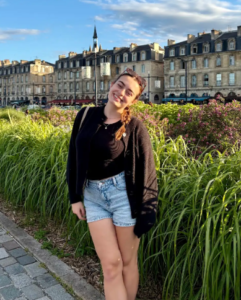 Krista Tannant was drawn to the Synergy program because she wanted to experience life as a full-time researcher over the summer and to gain hands-on experience conducting independent research in a lab.
Under the supervision of Dr. Kota Mizumoto, Krista investigated the role of the protein kinase SAD-1 in presynaptic assembly using Caenorhabditis elegans as a model system. Specifically, Krista is studying how the long and short SAD-1 isoforms individually contribute to synapse organization in the DA9 motor neuron.
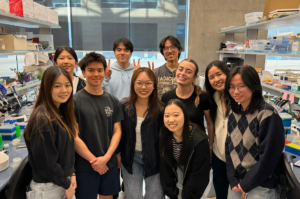 During the program, Krista worked on confocal microscopy to image neuronal synapses and gained experience in molecular techniques such as PCR and CRISPR/Cas9-based genome editing for strain generation and validation. She has also developed skills in data analysis, troubleshooting experiments, and presenting her findings in lab meetings and during conferences.
“This experience has given me a much better understanding of what a career in research looks like and has reinforced my interest in pursuing research after my undergraduate degree,” Krista reflects.
In the future, Krista plans to pursue a Master’s degree and continue to explore a career in research.
Cindy Zhang
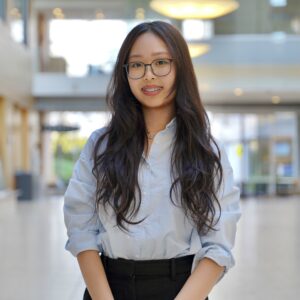
Cindy Zhang was drawn to the Synergy program because of her passion for neurobiology and wanted to develop practical and technical skills under direct research mentorship. Cindy wanted to gain immersive hands-on experience in computational neuroscience and to apply cutting-edge data analysis pipelines to uncover novel brain organization.
Under the supervision of Dr. Mark Cembrowski, Cindy’s project uses single-cell spatial transcriptomics to map inhibitory interneurons in the subiculum. By evaluating whether these interneurons exhibit spatially structured gene-expression patterns, Cindy aims to reveal how specialized local inhibition shapes output and circuit computation in this region.
 During the program, Cindy developed skills in computational analysis in R, using dimensionality reduction, integration and clustering techniques to identify and map interneuron subtypes, and participated in weekly lab meetings, journal clubs and one-on-one sessions with her PI, Dr. Cembrowski.
“This experience has transformed my perspective by showing me that foundational biological concepts, like canonical interneuron organization, are constantly open to revision through new technologies. Seeing data challenge established models firsthand has highlighted how important open-mindedness and multidisciplinary computational tools are to modern scientific discovery,” Cindy reflects.
In the future, she hopes to continue to bridge medicine and research to drive impactful advancements in patient care and clinical practice.
Lauren Keilty
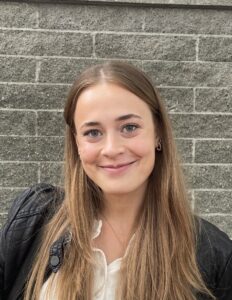 Lauren Keilty was drawn to the Synergy program to gain experience in biomedical technology research in a supportive and undergraduate-focused environment through workshops, research projects, and scientific communication opportunities.
Under the supervision of Dr. Stefanie Blain-Moraes, Lauren’s research focused on individualized machine learning models of autonomic nervous system responses and what they provide as a means of detecting moments of interactional engagement in individuals with advanced dementia.
During the program, Lauren learned technical skills such as research practices, signal processing techniques and machine learning model development. She has also gotten the opportunity to improve her critical thinking skills, engineering design approaches and communication skills.
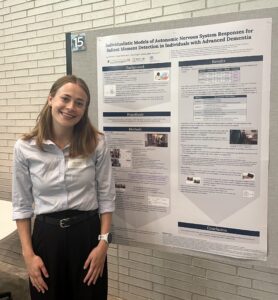
“The experience I had this summer getting to work on assistive technology has helped open my eyes to the importance of diversity and inclusion in research and development, and that engineering and technical design practices are best conducted with deep contextual knowledge of the user group that will utilize the technology,” Lauren reflects.
Lauren is exploring a possible career in biotechnology research, industrial biotechnology development or technological law, policy, or communications. She emphasizes that no matter the career she chooses, the knowledge and soft skills she has learned from the members of her lab will impact the way she interacts with others in her future profession.
Zubina Zafar
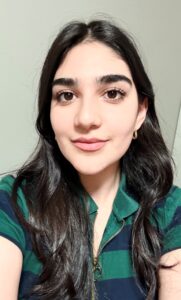 Zubina Zafar was drawn to the Synergy program because it offered her the opportunity to work directly with real patient data, learn neuroimaging techniques, and to receive mentorship from researchers across a variety of fields. She was excited about the idea of connecting with a program that bridges academic research and practical, translational science
Under the supervision of Dr. John Kramer, Zubina is investigating volume changes in the lateral hypothalamus (LHA) of the brain at various time points following spinal cord injury, comparing MRI volumetric data from SCI participants to neurologically intact controls to see how injury relates to volume changes in this brain region over time. She also explored what these volume changes in the LHA mean and how they translate clinically in terms of motor recovery in SCI patients.
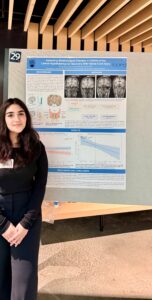 During the program, Zubina worked on structural MRI image segmentation for volume extraction using hypothalamic atlases in DSI Studio, mapped the atlases onto patient MNI native space and applied statistical modeling to longitudinal imaging data and building scientific communication skills through research presentations.
“This experience has shown me how research can build links between specific concepts like how changes in the lateral hypothalamus connect to glutamatergic projections that can influence motor function and recovery as an interesting pathway that holds a lot of functional relevance,” reflects Zubina. “This made me appreciate that scientific progress often comes from these deep connections between systems that can underlie any clinical breakthrough.”
In the future, Zubina hopes to contribute to bettering patient-centered care by exploring how findings such as the ones from her research can inform rehabilitation and treatment approaches for patients.
Heta Patel
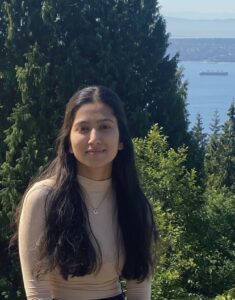 Heta Patel was drawn to the Synergy program because it allowed her to combine wet-lab research with computational frameworks in bioinformatics to study the cellular and molecular mechanisms behind neurological disease.
Under the supervision and guidance of Dr. Shernaz Bamji and mentored by her PhD student mentor Emma Breyak, Heta studied the molecular mechanisms that regulate neuronal development and how their disruption may contribute to neurodevelopmental disorders. They studied an enzyme family, zDHHC, known to meditate a process key in synapse formation and plasticity in neurons. Specifically, Heta looked at a specific enzyme, zDHHC8, predicted how specific patient variants affect this enzyme’s function by designing an ImageJ analysis to quantify the impact across variants.
During the program, Heta gained hands-on experience in wet lab research, including primary neuronal cultures, plasmid handling, transfection, nucleofection workflows, and fluorescence in-situ hybridization (FISH) experiments. She utilized both confocal and spinning disk microscopy for high-resolution imaging and subsequent imaging analysis. Heta’s most valuable experience during her time in the lab was independently executing a protein stability assay for the patient-derived variants. Managing an experiment with multiple complex conditions taught her the realities of benchwork and tight time management.
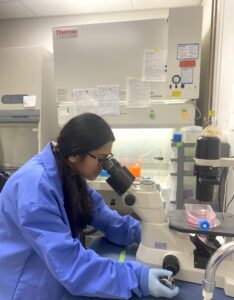
“My perspective on science completely shifted when I realized that wet lab results rarely fit a neatly expected story,” Heta shares. “I learned that research is not always a linear path to prove a hypothesis; rather, it requires navigating through negative data and experimental dead ends. During my project, working through these unexpected outcomes—such as finding that some mutations in the enzyme had no significant functional impact—proved just as valuable. Learning what didn’t work also saves critical time for other researchers and can help guide exactly where to take the experiments next.”
In the future, Heta hopes to pursue the clinician-scientist path because she wants to combine lab research and clinical practice. She hopes to keep looking into neuroscience at the cellular level to find the relevant targets that can continue to help improve real-world care for complex neurological diseases.