Congratulations to our current Graduate Program in Neuroscience (GPN) students who have received awards through the Canada Graduate Research Scholarships – Master’s program and the Canada Graduate Research Scholarships – Doctoral program from the Canadian Institutes of Health Research (CIHR). Learn more about our students and their research below!
Canada Graduate Research Scholarships – Master’s program
Nahanni Musiani
Project title: Electric Field Modelling of the Insular Cortex as a Response Predictor of rTMS for Depression
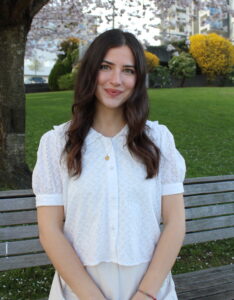 Nahanni completed her Bachelor’s of Science double major in Neuroscience and Psychology here at UBC, which allowed her to explore two perspectives of human experience that fascinates her the most.
“I think my interest in neuroscience stems from the human tendency to ask questions like, ‘What are we?’ and ‘How do we function?'” Nahanni shares. “My interest is also shaped by personal contact with psychiatric disorders, which have led me to wonder not only how we can better help people, but also why individuals experience mental health so differently.”
Nahanni’s current work is based in the Non-Invasive Neurostimulation Therapies Laboratory, directed by Dr. Fidel Vila-Rodriguez. Her thesis is focused on modeling transcranial magnetic stimulation (TMS) in depression using computational neuroscience techniques. Her aim is to further understand TMS and why it works for some but not others, and how to optimize treatments for better outcomes.
In the future, she hopes to continue with research while also integrating clinical work. Outside of the lab, Nahanni enjoys the company of her family and friends, and going hiking and kayaking.
Solana Redway-Ziola
Project title: Longitudinal Task-Based fMRI Analysis of Reward Processing in Children with ADHD from the ABCD Study
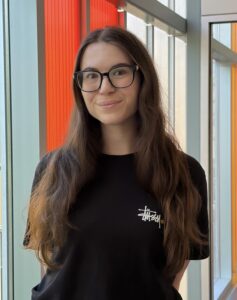 Solana completed her Honours Bachelor of Science in Psychology, Co-operative program at the University of Waterloo.
“During my undergraduate degree, I worked in cognitive, psychopathology, and neurodevelopmental research labs, which sparked my interest in neuroscience,” Solana reflects. “I found neuroscience to be the best fit for continuing my interdisciplinary interests while helping to better understand the intersection of cognition, mental health, and neurodevelopment.”
She is currently pursuing her Master’s in Neuroscience under the supervision of Dr. Todd Woodward. Solana’s thesis explores adolescents with ADHD and the differences and developmental changes in brain activity, and how these patterns relate to specific symptoms and potential subtypes. She is also interested in examining sex and gender differences in ADHD, as women often go underdiagnosed or diagnosed later in adulthood. Solana hopes to continue research in brain imaging, specifically in neurodevelopmental disorders.
Outside of research, Solana enjoys hiking and running, and is planning to run her first marathon this year! She also enjoys trying new bubble tea places and playing video games.
Katelyn Teng
Project title: Exploring the motivations and impacts of youth self-disclosure of mental health on social media
 Katelyn completed her Bachelor of Science in Neuroscience here at UBC. She is entering her first year in the Master of Neuroscience program under the supervision of Dr. Julie Robillard in the Neuroscience, Engagement, and Smart Tech (NEST) Lab.
The NEST Lab working to develop novel, emotionally-aligned tools to assist people with brain conditions. Katelyn’s thesis focuses on exploring the intersection between social media and mental health for adolescents. She will investigate the effects of youth self-disclosure of mental health conditions, such as anxiety and depression, on social media platforms.
“By nature, neuroscience is so multidisciplinary,” Katelyn shares. “The opportunity to work in neuroscience research means that I get to learn how neuroscience intersects with and is integral to fields like technology, psychology and healthcare.”
Kathelyn hopes to complete a PhD in the same research field and to contribute more knowledge as a neuroscience researcher. Outside the lab, Katelyn enjoys baking, collecting vinyl records and visiting her favourite coffee shops.
Lana Rummel
Project title: The Cornea: A Transparent Window into Neurodegeneration in Alzheimer’s Disease
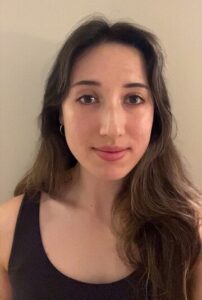 Lana completed her Bachelor of Science in Biology and Psychology. She is currently in Dr. Joanne Matsubara’s lab, where they study neurodegenerative diseases such as Alzheimer’s and how it affects the brain and the eye, especially in understanding and imaging the role of inflammation, immune responses, and changes in neurons in disease progression. Lana’s thesis is investigating biomarkers in the eye, specifically the cornea and other ocular surfaces, in individuals with Alzheimer’s.
Lana enjoys the interdisciplinary aspect of neuroscience.
“It brings together so many different areas like biology, physiology, pharmacology and pathology to answer really complex questions about how the nervous system works and what happens in disease,” she explains. “I also like that the research can have a meaningful impact, especially in areas like neurodegenerative diseases, where improving our understanding could eventually help with earlier diagnosis or better treatments.”
Lana hopes to combine research and clinical care by pursuing neuroscience research while also working with patients affected by neurological disorders. Outside of research, she loves to play tennis, hike, play instruments and hang out with her friends.
Kyler Pressman Cyna
Project title: Multimodal Profiling of Brain-Gut-Blood Interactions Underlying Domain-Specific Cognitive Impairment in Parkinson’s Disease
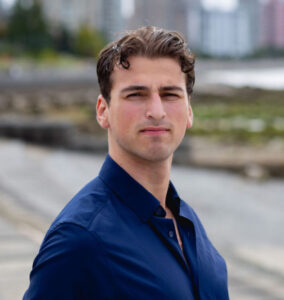 Kyler completed his Bachelor of Science in Neuroscience here at UBC, where he studied the neurobiological mechanisms of addiction in Dr. Catharine Winstanley’s lab
He is currently pursuing research under the supervision of Dr. Silke Appel-Cresswell, and his thesis focuses on the effects of mindfulness, exercise, and diet interventions on Parkinson’s disease. He uses MRI to investigate changes in brain connectivity and analyze how it is related to cognitive outcomes in participants.
“I initially chose neuroscience because I was fascinated by human behaviour and wanted to understand why we act in such complex ways,” Kyler says. ‘As my studies progressed, I was left with so many new questions that I now have a deep desire to help answer.”
Kyler’s primary future goal is to continue conducting research. While he has yet to narrow down a specific career path, he ultimately wants to pursue meaningful work and directly help people and improve their quality of life.
Outside of research, Kyler enjoys staying active by running, biking, skiing, hiking and bouldering. He also enjoys playing the guitar and baking.
Joel Rivera
Project title: Investigating and restoring Parvalbumin-expressing interneuron development in Huntington’s Disease
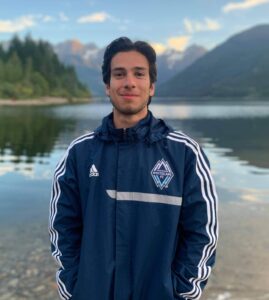 Joel completed his Bachelor of Science in Biology here at UBC, where he was awarded the presidential major entrance scholarship. He worked as a lab manager for two years at the University of Victoria in the Division of Medical Sciences before returning to UBC to pursue his Master’s.
Under the supervision of Dr. Lynn Raymond, he and his lab mates are examining the pathology of Huntington’s disease. His thesis focus is on parvalbumin interneurons and how they are affected throughout the progression of Huntington’s disease and its potential as a therapeutic target.
“While at UVic, I specialized in calcium imaging and super-resolution microscopy. This experience transformed my curiosity about the brain into a commitment to neuroscience,” Joel reflects. “Using these tools to investigate the genetic basis of syncope and seizure disorders in the Gitxsan First Nation of northern BC showed me how neuroscience can connect cutting-edge discovery with meaningful community impact.”
Joel hopes to continue working in clinical neuroscience, either as a scientist investigating novel therapeutic targets or as a clinician. Outside of the lab, he hopes to earn a Red Bull feature for “some preposterous alpinist feat.”
Matteo Paventi
Project title: Relation Between Sex, Sex Hormones, Symptoms, and Network Connectivity in Parkinson’s Disease
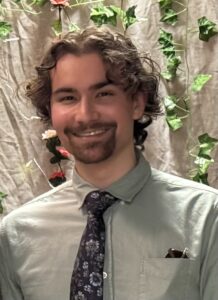 Matteo graduated with an Honours Bachelor of Science in Psychology from the University of Toronto. There, he studied both animal models and youth populations with techniques such as immunohistochemistry and neuroimaging. Motivated by his granny’s experience with Parkinson’s disease (PD), whom he calls his rock, he decided to move to Vancouver to pursue his graduate studies under the supervision of Dr. Silke Appel-Cresswell.
In the Cresswell Lab, Matteo’s thesis focuses on how sex hormones relate to structural and functional connectivity, and motor and non-motor symptoms in Parkinson’s disease (PD). He hopes to inform the lack of literature on women with PD.
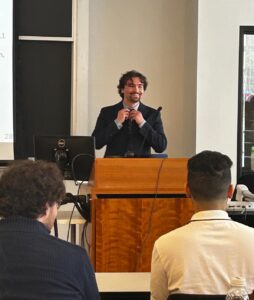
Matteo presenting his honours thesis
“I chose neuroscience because of how much remains unknown about the brain and the vast scope of what is left to be discovered,” Matteo explains. “As someone who has always been drawn to learning and research, I found it compelling that I could use a variety of neuroimaging techniques to observe how the brain develops, adapts, and functions across the lifespan to address some of the many unanswered questions in the field.”
Matteo hopes to work as a researcher in his own lab to study the biopsychosocial foundations of PD across different cultures.
Outside of the lab, he enjoys volunteering, running, going to the gym, listening to music and playing a variety of sports, including hockey, baseball, lacrosse and soccer.
Matthew Leung
Project title: Probiotics Treatment for Depression in Parkinson’s Disease
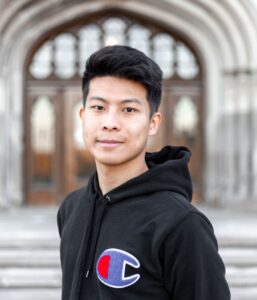 Matthew has a history in music research in Ontario, and as an avid musician himself, he focused on Rhythmic Auditory Stimulation (RAS) for individuals with Parkinson’s disease. He investigated how different musical properties improve people’s walking abilities with PD, and whether these effects explain connectivity of motor and auditory brain areas through imaging.
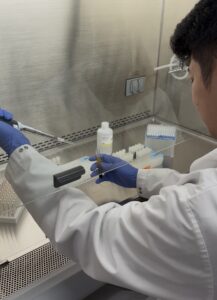
Matthew in the lab
He is currently a graduate student working with Dr. Silke Appel-Cresswell in the Pacific Parkinson’s Research Centre at UBC, and his thesis focus is investigating probiotic treatment on depression and the gut microbiome in PD. His 12-week randomized, triple-blind, placebo-controlled clinical trial is looking to meaningfully enhance daily functioning and long-term outcomes for people with PD.
After Matthew learned about the homunculus in high school, it motivated him to explore different domains of neuroscience research. He integrated both passions of music and the brain throughout his undergraduate degree, where the opportunity to research musical effects on Parkinson’s gait sparked his interest in continuing Parkinson’s research here at UBC.
Outside research, Matthew continues to enjoy playing music. He loves watching sports and classical concerts, as well as exploring different coffee shops and restaurants in Vancouver.
Natalie Ma
Project title: Investigating the Role of Microglial Senescence in Schizophrenia Pathology

Natalie completed her Bachelor of Science in Honours Biology here at UBC, where she conducted two thesis projects. The first was with the Matsubara Lab, where she studied Age-Related Macular Degeneration, the third leading cause of blindness. The second was conducted at the Ciernia Lab, where Natalie studied the gut microbiome and its affects on microglial morphology and corticosterone levels across development.
Currently, Natalie is a first year in the Master of Neuroscience program under the supervision of Dr. Clare Beasley. Her thesis project focuses on investigating immune mechanisms driving accelerated brain aging in schizophrenia. Specifically, she is focused on determining whether microglial senescence is increased in post-mortem brain tissue samples from individuals with schizophrenia and their relationship with aging biomarkers in the brain and blood.
“Having witnessed the profound impact that brain-related disorders can have on those around me, I became motivated to understand how the brain works,” Natalie shares. “I chose to pursue neuroscience research due to its immense potential to improve lives by deepening our understanding of complex brain conditions to improve treatments.”
Natalie hopes to pursue a career that allows her to improve lives through the knowledge she gains from working and learning in the neuroscience field. Outside of the lab, Natalie enjoys reading, exploring new restaurants and cafés around Vancouver, and volunteering with the BC Brain Wellness Program and in the Human Resources Committee at the Graduate Student Society.
Canada Graduate Scholarships – Doctoral program
Ava Momeni
Project title: Toward precision psychiatry: using large-scale functional magnetic resonance imaging (fMRI) data to investigate brain-based subtypes of attention-deficit/hyperactivity disorder in children
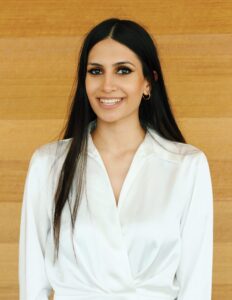 Ava completed her Bachelor of Science in Neuroscience with a minor in Gender, Race, and Social Justice, and a Master of Science in Neuroscience, both from UBC. She is currently conducting research at the Brain Dynamics Lab, supervised by Dr. Todd Woodward, where they investigate brain patterns that are associated with various cognitive processes and how these patterns are affected in various psychiatric conditions. Her thesis focuses on investigating the brain-based subtypes of ADHD in children using movie-based fMRI.
“In the book The New Mind Readers, Dr. Russel Poldrack posed the question, ‘how can three pounds of tissue perform mental feats that outstrip the ability of the world’s most powerful computer while consuming less energy than a dim lightbulb?'” Ava shares. “This question perfectly encapsulates my fascination with the human brain, which has propelled me to pursue a research career in neuroscience.”
Ava hopes to become a professor specializing in cognitive neuropsychiatry research to improve children’s health. Outside of research, she loves nature therapy, reading and spending time with her family and friends.
Isa Samad
Project title: Enabling regeneration of the injured spinal cord
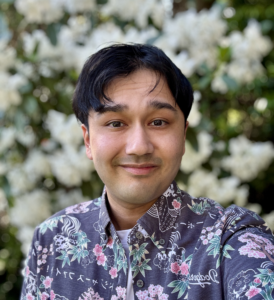 Isa completed his Bachelor of Science in Neuroscience from the University of California, Los Angeles, where he completed his honours thesis investigating cortical circuit plasticity and functional recovery following ischemic stroke.
“Ever since middle school, I’ve been fascinated by the remarkable precision with which neurons form synaptic circuits, enabling the nervous system to process information across large-scale networks,” Isa notes. “Understanding how these processes break down after injury or disease and exploring strategies to promote plasticity and repair neural connections are major passions driving my research in neuroscience.”
Isa is currently a third-year PhD candidate in Dr. Brett Hilton’s lab at ICORD, a lab that focuses on understanding mechanisms that regulate axon regeneration after a spinal cord injury. His thesis focuses on understanding epigenetic mechanisms, specifically focusing on a process called chromatin remodeling, and its role in regulating axon regeneration after a spinal cord injury. Isa hopes to pursue a career as a physician-scientist.
Outside the lab, Isa loves to learn new languages and engage in cultural exchange. He minored in Japanese and is learning Korean and Spanish! He also loves to watch baseball, basketball and golf.
Christy Kwok
Project title: Multi-Scale Investigation of Cellular, Circuit, and Behavioral Phenotypes in Huntington’s Disease (HD)
Also a huge congratulations to all of the trainees being supervised by DMCBH members who have also received scholarships:
Canada Graduate Research Scholarships – Master’s program
Danielle Go
Project title: Proteomic Analysis of Inflammatory and Neurological Blood Biomarkers in Acute and Chronic COVID-19
Supervisor: Cheryl Wellington
Julia Groening
Project title: Using living human brain tissue to model and causally interpret Alzheimer’s disease
Supervisor: Mark Cembrowski
Angela Peng
Project title: Social robots in the support of child mental health: Patient experience of a Miro-E based intervention
Supervisor: Julie Robillard
Emily Schraeder
Project title: Investigating the effects of early pain and sucrose exposure on brain development using a newborn mouse model
Supervisor: Manon Ranger
Nima Teymouri
Project title: Uncovering the sex-specific contribution of astroglial M1 muscarinic receptor signaling to Alzheimer’s disease pathophysiology
Supervisor: Khaled Abdelrahman
Canada Graduate Scholarships – Doctoral program
Kidus Achalu
Project title: Proteomic profiles of youth sports-related concussion and traumatic brain injury
Supervisor: Cheryl Wellington
Mohammad Ghodsi
Project title: Blood-Based Biomarkers of Brain Injuries Caused by Intimate Partner Violence
Supervisor: Cheryl Wellington
Brian Liu
Project title: Safety of prescribed symptom self-monitoring following mild traumatic brain injury
Supervisor: Noah Silverberg
Ryan Loke
Project title: Mapping structural brain alterations in chronic pain: a multi-metric, individual participant data approach
Supervisor: John Kramer
Huan Ly
Project title: The evolution of brain injury and its impacts on the brain structural maturation and neurocognitive outcomes in adolescents and young adults with congenital heart disease
Supervisor: Thalia Field and Thiviya Selvanathan
Mathilde Rioux
Project title: Functional Cognitive Disorder: Predisposing and Perpetuating Factors
Supervisor: Noah Silverberg
Sidney Saint
Project title: Brain health and behavioural consequences of overdose-associated hypoxic brain injury and traumatic brain injury: Data from a 15-year cohort study of health in residents of Vancouver’s Downtown Eastside
Supervisor: William Panenka