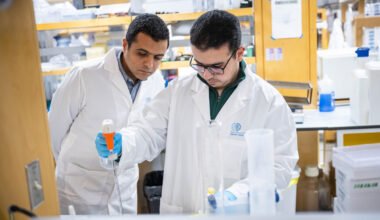
What if a simple blood test could help detect brain disorders like dementia, concussion and stroke?
That could soon be possible thanks to a newly opened core facility at the University of British Columbia (UBC) that aims to improve the diagnosis and treatment of neurological diseases, positioning Canada at the forefront of blood biomarker research.
Led by Dr. Cheryl Wellington, the Core Facility for Neurology Biomarker Innovation (CFNBI) has officially opened as one of the Djavad Mowafaghian Centre for Brain Health’s (DMCBH) core facilities in a renovated laboratory space at UBC Hospital.
The facility, which is the first of its kind in Canada, will support the development of blood-based tests for various brain conditions to help clinicians detect disease earlier, guide more precise treatment, and improve patient outcomes through faster, less invasive and more accessible clinical tools.
Using blood tests to better understand brain disorders
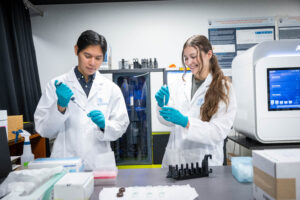
The CFNBI’s Biomarker Technicians
Brain disorders remain among the most difficult conditions to diagnose and treat. Unlike cancer, where tissue biopsies are routinely collected, neurological diseases are often diagnosed using subjective clinical assessments, expensive imaging technologies or invasive cerebrospinal fluid procedures.
The CFNBI is working to change that through fluid biomarkers, which are biological signals found in blood or other bodily fluids that can reveal what is happening in the brain. Compared to traditional approaches, blood-based biomarker testing is quicker, non-invasive and easily repeatable over time, offering a more accessible window into brain biology.
“Biomarkers are indicators of normal biological processes, disease processes, or responses to treatment,” says Dr. Wellington, Professor and Vice Chair of Research in the Department of Pathology and Laboratory Medicine at the UBC Faculty of Medicine. “Our goal is to develop tools that make brain health assessment more accessible and precise, and better understand individual risk—all using a routine blood sample.”
Advanced technology for brain health research
The CFNBI houses a range of specialized technologies designed to detect subtle biological signals associated with brain health and disease. These include state-of-the-art protein detection analyzers, which can simultaneously measure more than 120 types of brain and inflammatory markers in blood samples. For rapid testing applications, a hand-held, portable point-of-care testing device can measure brain injury biomarkers from a single drop of blood in just 15 minutes.
“The analyzers in the CFNBI give us the ability to detect extremely small amounts of proteins in blood that reflect changes happening in the brain—something that was not previously possible,” says Dr. Robin Hsiung, an Associate Professor of Neurology, a clinician-scientist in UBC’s Clinic for Alzheimer Disease and Related Disorders and collaborator with the CFNBI. “Having accessible blood tests has the potential to significantly improve diagnosis and accelerate development of new therapies for patients with dementia.”
Together, these platforms allow researchers to study neurological disease at multiple levels, from rapid bedside screening to large-scale molecular analysis.
A growing collaborative network
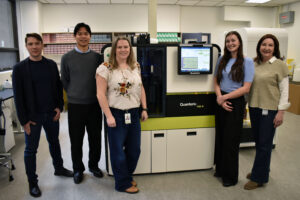
The CFNBI team
Since 2016, Dr. Wellington and her team have been building an internationally renowned, collaborative research program focused on advancing blood biomarkers, and the launch of the CFNBI marks a major next step.
Recent collaborations with DMCBH clinician-scientists, including Drs. Brian Kwon and Mypinder Sekhon, are exploring the use of fluid biomarkers as diagnostic, prognostic and management tools for spinal cord injury and critical care.
“Blood-based biomarkers also have the potential to transform how we assess spinal cord injuries, particularly in the critical early stages when detailed neurological examinations may not be possible,” says Dr. Kwon, a Professor in the Department of Orthopaedics and the Director of ICORD. “Our collaboration with Dr. Wellington’s team is helping advance tools that could improve injury assessment, recovery prediction and ultimately patient care.”
“Working with Dr. Wellington’s team, we have been able to mobilize biomarker research to respond to urgent clinical challenges,” says Dr. Sekhon, a Clinical Associate Professor and Division Head for UBC Critical Care Medicine at Vancouver General Hospital. “Because we already had the technology and research infrastructure in place, we were able to rapidly pivot our work during the pandemic and identify inflammatory biomarkers in patient blood samples that helped guide new directions for treatment and care.”
Other CFNBI projects span pediatric brain health after surgery, the effects of wildfire smoke on the brain and even monitoring brain health in space. Beyond UBC, the CFNBI also collaborates with national organizations including Statistics Canada, the Canadian Consortium for Neurodegeneration in Aging and the Canadian Traumatic Brain Injury Research Consortium, along with industry partners such as Quanterix, Alamar, Abbott, Siemens and Fujirebio.
Since its inception, the CFNBI research team has published 51 papers and supported more than 70 collaborative projects involving over 142 collaborators across academia, healthcare and industry. Over this time, Dr. Wellington and her team have also helped secure more than $75 million in research funding, including $16 million directly supporting CFNBI activities.
Supporting discovery across the lifespan
The CFNBI supports biomarker research across the full continuum of discovery, validation and clinical implementation. Its work spans neurodegenerative diseases such as Alzheimer’s disease, traumatic brain injury, cerebrovascular disease, neuroinflammatory conditions, and studies of healthy brain development and aging.
As neurological disorders continue to rise worldwide, the facility aims to accelerate the development of accessible, low-cost tools that can improve diagnosis, research and patient care in Canada and beyond.
“Ultimately, we hope to expand equitable access to emerging technologies and build collaborations that will accelerate translation from the lab to clinical care,” says Dr. Sophie Stukas, the CFNBI’s Research Director.
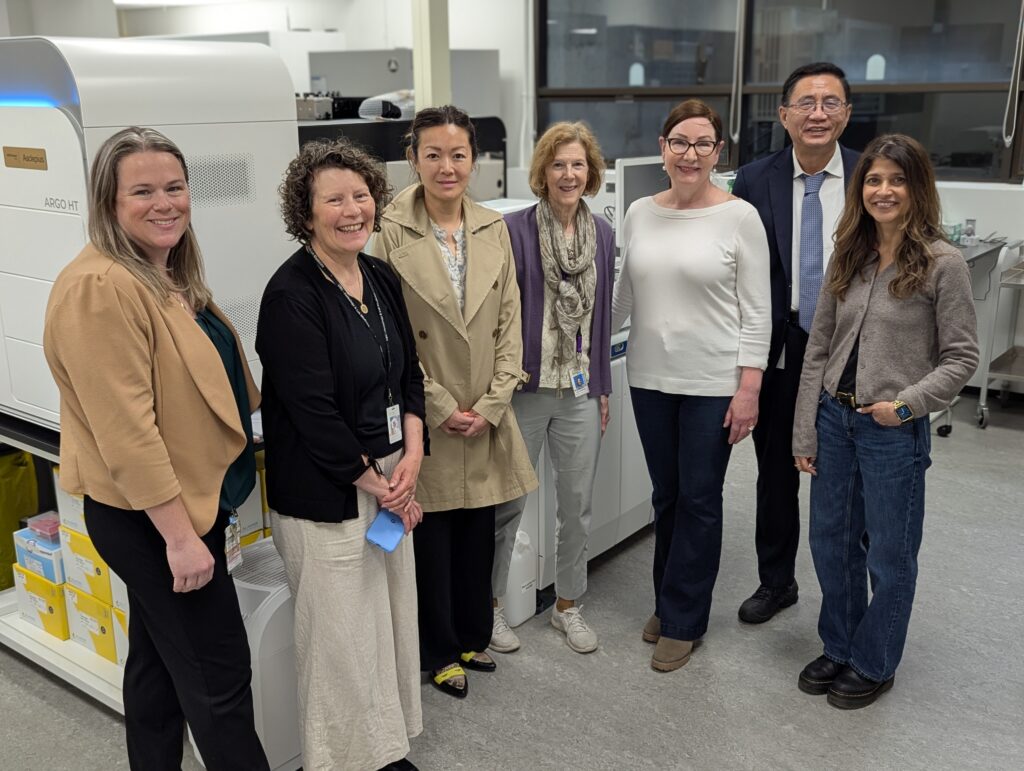
UBC leadership including representatives of the Department of Pathology (Dr. Zu-hua Gao, Department Head, and Genevieve MacMillan, Director, Human Resources and Administration), DMCBH (Dr. Lynn Raymond and Dr. Shernaz Bamji, Co-Directors), and Faculty of Medicine (Dr. Michelle Wong, Senior Director, Research) visit the CFNBI.