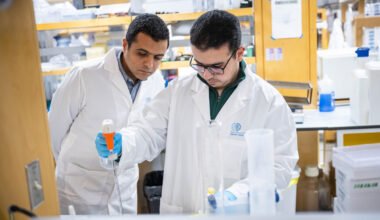
When commercially available behavioural testing equipment is out of reach, some researchers get creative and build their own.

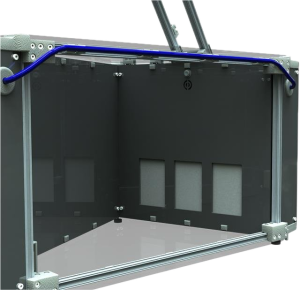
That’s exactly what Gelareh Modara, a Master’s student in Dr. Manu Madhav’s NC4 Lab and Dr. Jason Snyder’s Lab, set out to do with NC4 Touch, a new open-source touchscreen chamber for rodents, designed to support cognitive and behavioural neuroscience research.
Originally inspired by a research question about how early-life sensory exposure shapes adult learning, the project soon expanded into something broader: technological development.
DIY Touchscreen technology
“Our project is a do-it-yourself behavioural training assay for rodents,” she explains. “It’s called NC4 Touch, and it’s used to test learning, memory, attention—really any kind of cognitive function. It features three touch screens that rodents interact with by nose-poking or touching with their paws. It’s actually pretty adorable sometimes.”
Touchscreen-based testing has become increasingly popular in neuroscience due to its precision, low stress for animals and strong translational value. Many of the paradigms used in these systems are adapted from the Cambridge Neuropsychological Test Automated Battery (CANTAB), which is widely used in human cognitive testing, particularly for neurodegenerative diseases like Alzheimer’s and Parkinson’s. By mimicking these tasks in rodents, researchers can more easily draw connections between animal models and human cognitive function.
Instead of relying on off-the-shelf systems, the team decided to develop a customizable, open-source alternative that could be shared with others.
“We wanted to build something that was open-source, affordable and easy to use,” Gelareh notes. “And not just for us, but for other labs looking to do similar work.”
Engineering meets neuroscience in the NC4 Lab
The NC4 Lab is well known for its interdisciplinary work at the intersection of engineering and neuroscience. Principal Investigator Dr. Manu Madhav—a robotics, controls and mechanical engineer turned neuroscientist—fosters a culture of innovation where students and postdocs lead the development of custom experimental tools. Current projects include the Omniroute maze by Dr. Adam Lester, the Dome in collaboration with Skylar Fang and immersive virtual reality assays that bridge technical design and behavioural research.
The result is the NC4 Touch—a sleek, functional chamber with customizable hardware and software—entirely open-source and developed through a rigorous, collaborative process.
“I didn’t have a technical background—just some experience with R for data analysis in behavioural neuroscience—so I had to learn about hardware and software from scratch,” Gelareh recalls.
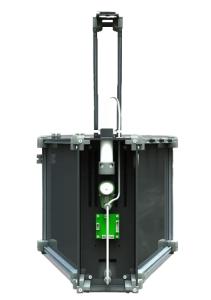 That learning process was made possible through partnerships with other trainees in the lab. Early prototypes were co-designed with fellow graduate student Isaac Schwein, who helped translate the ideas into 3D models. As Gelareh tested prototypes with mice and rats with the help of other undergraduate researchers, she iterated—adding features, resolving issues and refining usability. Later versions benefited from input by postdoctoral researcher Dr. Adam Lester, an experienced tool developer who offered key insights into physical design and functionality.
“It was a very iterative process of troubleshooting on the go, adding new features and seeing if it works out, both for the user and for the animals,” she explains. “It was a team effort all the way through, and I learned a lot from the people around me. That collaboration was what made my project possible.”
Empowering the neuroscience community through open science
The finished chamber now forms the centrepiece of Gelareh’s Master’s thesis, which also includes the design of a passive exposure. Photos and protocols are available to other labs, fulfilling the team’s original goal: making cognitive testing more accessible and adaptable across research environments.
“Collaboration and open science are essential to advancing neuroscience,” says Dr. Madhav. “When we build tools that are open-source and shareable, we empower other researchers to explore new questions—and accelerate discovery for the entire field.”
See NC4 Touch in Action:

By Amy Wong