Pictured above from left to right: Giulia Cocco, Dr. Tim O’Connor, Dilni Dissanagake, Sarah Li, Yixuan Wu, Emma Wei, Ella Yan, Margarita Kapustina and Isa Samad.
On April 5th, 66 high school students gathered at the Djavad Mowafaghian Centre for Brain Health (DMCBH) for the 17th annual Vancouver Brain Bee—an exciting day of scientific curiosity, friendly competition and discovery. Modelled after the Spelling Bee, the Brain Bee tests high schoolers in Grades 9 through 12 on their knowledge of the brain and nervous system. Students explore a variety of topics including memory, emotion, perception, stress, aging, neurotransmitters and genetics.
The Brain Bee is held in 30 countries worldwide, with local, national and international competitions. In Vancouver, the Brain Bee is sponsored by the UBC Life Sciences Institute, DMCBH, Canadian Institutes of Health Research and the UBC Graduate Program of Neuroscience.
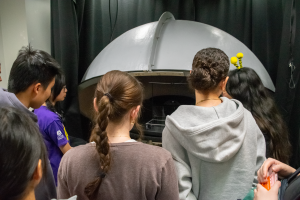
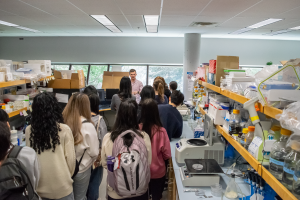
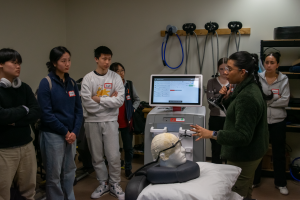
Co-hosted by Neuroscience Master’s students Giulia Cocco and Isa Samad, the event began with opening remarks by Dr. Stan Floresco in the Rudy North Lecture Theatre. The day’s schedule was packed: after the written exam, participants toured neuroscience labs, enjoyed a pizza lunch, and played mini-games before reconvening for the dramatic final round.
The highlight of the day was the Jeopardy-style oral competition. The top five finalists answered questions from judges Dr. Timothy O’Connor and PhD student Margarita Kapustina from Dr. Mark Cembrowski’s lab. Each answer was met with anticipation as students demonstrated their determination and knowledge under pressure.
The 2025 winners were:
- Dilni Dissanagake (1st place)
- Yixuan (Shine) Wu (2nd place)
- Emma Wei (3rd place)
- Sarah Li (4th place)
- Ella Yan (5th place)
For first-place winner Dilni Dissanagake, this year’s competition marked the culmination of a two-year journey.
“My experience at the Brain Bee was a pivotal moment in my life,” she said. “I was actually a part of the Brain Bee last year, and my previous experience pushed me to work really hard to achieve my dream of placing first.”
Drawing on the lessons from her earlier attempt, Dilni described how confidence replaced nerves during the oral round—a moment that stood out not only for its intensity, but for what it revealed about her personal growth.
“It was nerve-wracking, as this was my last year to make my dream come true since I’m in Grade 12,” she recalled. “But as I kept answering the questions, I could feel my worry dissipate and be replaced with determination. I felt confident that I could answer any question that came at me at that level.”
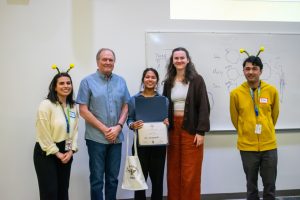
First place winner Dilni Dissanagake receives her prize from the Brain Bee organizers and judges.
Dilni’s interest in neuroscience is deeply personal.
“People close to me were greatly impacted by mental health struggles, so that was the catalyst,” she explained.
As she delved deeper into the subject, what kept her hooked was the brain’s intricate design and complexity. She has long been drawn to developmental and psychiatric disorders, but the competition sparked a new fascination with neuroanatomy.
“After reviewing a lot of neuroanatomy for the Brain Bee, I can confidently say that that is a subject that I find very interesting,” she reflected. “It’s fascinating how so many small components make up this remarkable organ.”
Looking ahead, Dilni has ambitious dreams to become a neurosurgeon.
“Neuroscience has been a big part of my life through my academic choices and who I identify as—a science student— so it only feels right to help others with this interest of mine.”
From blooming curiosity to career aspirations, the Vancouver Brain Bee continues to inspire the next generation of brain scientists and clinicians. Congratulations to all the participants—and especially to this year’s finalists—for a phenomenal showing.
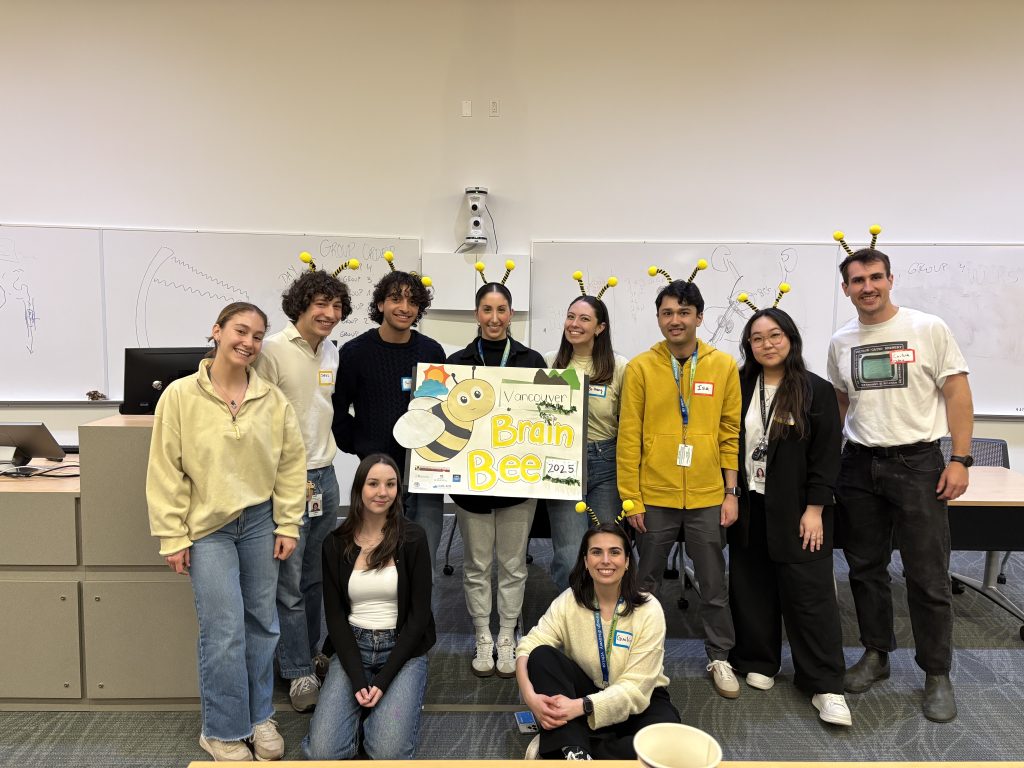
Thanks to all of the volunteers who made this event possible!


