UBC launches the Dementia Therapeutics Innovation Initiative and names the Kenneth W. McArthur Neurodegenerative Research Floor in the Djavad Mowafaghian Centre for Brain Health.
Guided by loyalty to close friends, alma mater and country, UBC alum Ken McArthur and his wife, Sheila, have made a landmark gift that advances innovative Alzheimer’s research and strengthens UBC’s leadership in therapeutic discovery and translation.
The McArthurs’ philanthropy catalyzed an interdisciplinary team and launched the Dementia Therapeutics Innovation Initiative with a clear and ambitious goal: to develop and test new therapies for Alzheimer’s disease at UBC.
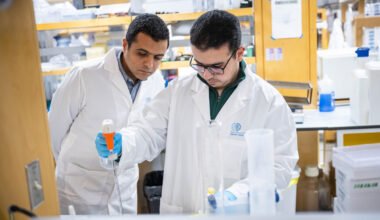
The initiative brings together research facilities, scientists with diverse expertise and advanced tools to identify the genes, proteins and biological processes involved in Alzheimer’s. The next step is to develop new drugs that target these processes to treat the disease.
“Thanks to Kenneth McArthur’s vision and generosity, UBC scientists can advance Alzheimer’s research in transformative ways,” says UBC President and Vice-Chancellor, Benoit-Antoine Bacon. “This critical work shifts the focus from degeneration to resilience, positioning UBC at the forefront of a new way of thinking about Alzheimer’s and its treatment.”
Building capacity for excellence at UBC
In 2020, McArthur invited his longtime friends Brian Aune, Ruth Glenen and Ken Copland to join him in supporting Alzheimer’s research at UBC. Together, this group had navigated the economic turbulence of the 1970s and later witnessed the quiet cruelty of Alzheimer’s. They saw the disease move slowly, leaving beautiful people present yet profoundly changed, as spouses devoted their lives to caring for loved ones whose light had faded.
“We need to do something about this,” said McArthur, BCom’61 to his friends.
That same sense of loyalty led McArthur back to his alma mater. His commerce education, combined with work experience at an accounting firm through a program similar to today’s co-op, helped shape his successful career in investment banking that took him from Nesbitt Thomson in Montreal to Toronto and Wall Street. Already donors to UBC, the McArthurs support students in the Sauder School of Business and School of Nursing.
“When I came back to UBC, I wanted to find out if they had the capacity to develop a serious Alzheimer’s research program,” says McArthur. He met with Dr. Brian MacVicar, Canada Research Chair in Neuroscience, and Dr. Haakon Nygaard, Fipke Professor in Alzheimer’s Research and Director of the UBC Hospital Clinic for Alzheimer and Related Disorders, an academic teaching and research clinic that serves patients throughout British Columbia.
McArthur saw the leadership and expertise he was looking for, but not the well-funded team he knew was needed to solve such a complex challenge. The friends’ first gift launched a new research collaboration between Drs. MacVicar and Nygaard and enabled them to build their team by engaging Dr. Freda Miller, Professor in the Department of Medical Genetics and School of Biomedical Engineering at Michael Smith Laboratories, and funding essential work by postdoctoral researcher, Dr. Stefan Wendt.
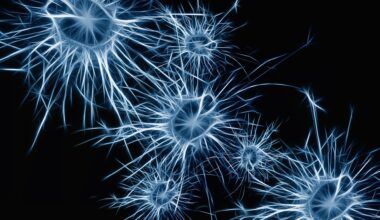
The team used stem cells derived from the blood of patients to develop 3D models of human brain cells called neurospheres. With state-of-the-art neuroimaging, the researchers found that microglia, the immune cells of the brain, offer protection from the damage caused by oxidative stress triggered by the presence of amyloid, a protein associated with Alzheimer’s.
All in and moving closer to a treatment for Alzheimer’s
Impressed by the team’s early progress, the McArthurs and the Aune Foundation expanded their support, enabling the launch of the Dementia Therapeutics Innovation Initiative. Specialized equipment is being purchased and research manager was hired to oversee the growing team, which will include additional graduate students and postdoctoral fellows. Dr. Xin Tang, Assistant Professor in the Department of Computer Science, also joined the collaboration, bringing new expertise in neuroinformatics.
The team is scaling up production of neurospheres to run large screening studies. They are examining how cells behave in Alzheimer’s disease and identifying the most promising targets for the next stage of development.
“Now, because of philanthropy, we are undoubtedly a little closer,” says Dr. Nygaard. “Donor support has enabled us to start identifying fundamental biological pathways driving Alzheimer’s disease using sophisticated bioinformatics methods that few institutions can rival. We anticipate this will allow us to discover new targets and eventually turn these findings into new drugs.”
McArthur is confident the Dementia Therapeutics Innovation Initiative now has the right team and bold, ambitious approach to emerge as a world-class leader.
“I’m all in,” says McArthur. “I am very hopeful their research will be successful because I would love UBC to get the recognition. That would be the greatest satisfaction of my life.”
Now, each day, the team passes the sign for the Kenneth W. McArthur Neurodegenerative Research Floor on their way to work—a quiet reminder of his legacy. For them, McArthur had one request:
“When people ask, ‘Who was this guy?’ The answer I’d like you to give is this: It was someone who cared. That’s what it’s all about.”