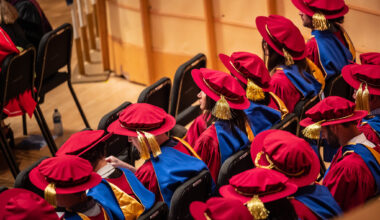
Congratulations to the Graduate Program in Neuroscience (GPN) spring class of 2025! 13 trainees graduated last week and to celebrate, we asked them to share some of their favourite memories during their time at UBC, their future plans and advice for future students.
Peter Hogg, PhD
 Supervisor: Dr. Kurt Haas
Thesis title: Information driven refinement of the dendritic arbor in vivo
Summary of research: In this thesis, I used in vivo imaging to uncover new principles governing how visual experience shapes synaptic connectivity in the developing brain. These findings advance our understanding of neuronal circuit formation and may provide insight into the mechanisms underlying neurodevelopmental disorders.
Favourite GPN memory: My favourite memory has to be lab camping trips in the Squamish River Valley. It was a great team-building time and created countless memories in the beautiful wilderness of BC.
Future plans: I am planning to further my research and training as a postdoctoral fellow.
Advice for future students: Just be consistent. There will be times when you need to work long hours, but real progress comes from showing up regularly and making incremental gains day by day.
Jennifer Kim, PhD
 Supervisor: Dr. Annie Ciernia
Thesis title: Harnessing novel tools to explore transcriptomic patterns that shape microglial morphology
Summary of research: Microglia are dynamic immune cells in the brain that change shape in response to environmental cues, but how these changes relate to gene expression is not well understood. My dissertation work focused on using new analysis approaches to connect microglial shape to gene expression to better understand their roles in the brain.
Favourite GPN memory: It is hard to name a single favorite memory, but two that stick out to me are 1) The Jovies, which was an Oscars-style award ceremony our lab held for ourselves (red carpet and all) in honour of our Jove protocol video, a cinematic masterpiece; and 2) Karaoke at the DMCBH holiday party 2023 – jamming out to Queen with my PI and others was pretty epic.
Future plans: I will be moving to Baltimore, Maryland this summer to start my postdoc with Dr. Kristen Maynard at the Lieber Institute for Brain Development.
Advice for future students: Grad school is a really special and protected period of the career where you have more freedom and dedicated time to learn and grow as a scientist. You have the power to shape your time in the degree, so be intentional and thoughtful with your decision making. If you really want to gain expertise in a subfield or build a certain skillset, plan accordingly and seek good mentors in/out of the lab and learning opportunities that can help you achieve those goals!
Bonnie Lee, PhD
 Supervisors: Drs. Liisa Galea and Teresa Liu-Ambrose
Thesis title: Sex and sex-specific factors influence brain health at middle age depending on APOEε4 genotype
Summary of research: Alzheimer’s disease disproportionately affects females, and this sex difference is further exacerbated by the presence of apolipoprotein E (APOE) ε4 alleles, the top genetic risk factor for late-onset sporadic AD. To further understand these sex differences, it is pertinent to investigate the contributions of sex-specific factors, including parity (pregnancy and parenthood). Leveraging a preclinical model, my research identified sex differences in the effects of APOEε4 genotype on hippocampal neuroplasticity and microglia, and further revealed that pregnancy history has opposing effects on various biomarkers of brain health, including neuroplasticity and brain-wide functional activation patterns, depending on APOEε4 genotype at middle age. This research advances our understanding of women’s health and underscores the importance of considering within-sex factors in research.
Favourite GPN memory: It’s hard to choose just one, but attending my first in-person conference after the COVID-19 lockdown stands out as especially meaningful. After so much time apart, it was really energizing to be together again – reconnecting with colleagues and learning about the latest research. I was struck by the resilience of the scientific community and grateful that most of our lab could attend. The fact that it took place in sunny Marina del Rey for the Organization for the Study of Sex Differences made it all the more memorable!
Future plans: I am continuing my research as a Postdoctoral Fellow at the Centre for Addiction and Mental Health with Dr. Liisa Galea and at the Women’s Health Research Cluster. Alongside my research, I will be leading advocacy initiatives through the Women’s Health Research Cluster, aiming to drive systemic change and increase investment in women’s health research.
Advice for future students: Graduate school is such a unique chapter in your life and career – one where you truly get to shape your own path. Embrace it fully. Work hard and commit to doing rigorous, meaningful research, and don’t lose sight of your “why”. At the same time, don’t forget to immerse yourself in the network around you. Build connections, attend talks and events, and engage with the broader community. Most importantly, try to enjoy the journey!
Nicholas Michelson, PhD
 Supervisor: Dr. Tim Murphy
Thesis title: Methods to evaluate mouse dorsal cortical function during social and innate behaviours
Summary of research: I developed methods to study large-scale cortical activity in the mouse during social and innate behaviours. My work has shown that the brains of two mice synchronize during social interaction and that cortical neuron activity represents subcortically mediated behaviours.
Favourite GPN memory: My favourite GPN memory was the DMCBH research retreat at UBC Okanagan – it was a fun way to connect with others in the UBC neuroscience community and learn about all the cool research happening at DMCBH.
Future plans: I will begin a postdoctoral fellowship in Patrick Kanold’s lab at Johns Hopkins University.
Advice for future students: Negative results and dead ends are all part of the process. Learn how to adapt quickly and go with the flow.
Pearson Wyder-Hodge, PhD
 Supervisor: Dr. Dinesh Pai
Thesis title: Friction and affective touch: probing the role of skin mechanics in perception
Summary of research: I studied how human soft tissue properties shape light touch perception. I developed novel methods to measure friction across body regions, revealing force characteristics and velocity thresholds that define pleasant touch. My work informs clothing design, wearable tech, and identifying clinical populations with diverse touch responses.
Favourite GPN memory: Celebrating the completion of the NRSC grad courses with my cohort! These courses are a great way to bond with fellow Neuroscience graduate students.
Future plans: I will continue my research at UBC through a Mitacs Postdoctoral Fellowship, in partnership with Lululemon.
Advice for future students: If research in industry interests you, then find time during your graduate degree to do an internship or work part-time with an industry partner. It can be very rewarding and motivating to see your work and ideas drive a product.
Giulia Cocco, MSc
 Supervisor: Dr. Jason Snyder
Thesis title: How does early life stress affect adult behaviour in mice?
Summary of research: My project was on How Early Life Stress Affects Adult Behaviour In Mice. Using mouse models, my thesis explored how different kinds of stress during early development impact anxiety-like behaviour in adulthood even when the memory of said stressful events is forgotten.
Favourite GPN memory: One of my favourite memories was organizing the Vancouver Brain Bee with the Neuroscience Trainee Association (NTA). We formed a team to run every aspect of the event, from logistics to in-person classroom outreach, where we introduced high school students to the field of neuroscience. I loved getting students excited about science and was inspired by their enthusiasm and curiosity.
Future plans: I’m passionate about science and plan to pursue a healthcare-related career where I can apply what I’ve learned in a real-world setting. Ideally, I’d love a role that combines my neuroscience knowledge with patient interaction, as I enjoy connecting with people and making a tangible difference in their lives.
Advice for future students: Get involved in student organizations and make time for hobbies outside of school! It’s easy to feel isolated when starting somewhere new, but joining the NTA helped me build a network beyond my lab and introduced me to mentors and lifelong friends. I believe hobbies are important because they provide a sense of accomplishment, especially on those tough days in the lab when progress feels slow.
Katelyn Hudak, MSc
 Supervisor: Dr. Wolfram Tetzlaff
Thesis title: Towards a translatable approach to the inhibition of regeneration-impeding molecules following spinal cord injury
Summary of research: The overall objective of this thesis is to promote nerve regrowth using antisense oligonucleotides (ASOs), which block the production of inhibitory molecules that prevent regeneration following SCI. This project is inspired by the successes of ASO technology for several rare diseases in humans, rendering the results of this experiment translatable from laboratory to hospital. If successful, this project may provide a new means of tackling the regeneration failure and disability that follows human SCI.
Favourite GPN memory: Attending The International Symposium on Neural Regeneration, in Monterey, CA. I had the chance to attend the conference with my lab mates and we all celebrated our research accomplishments together. It was the perfect mix of education and fun in the sun.
Future plans: I attended medical school while I wrapped up my thesis, and will be working as a resident doctor next year.
Advice for future students: Completing a master’s degree is a lot of work! Don’t be too hard on yourself if some experiments fail or if you don’t get the results you were hoping for. Also, definitely lean on your lab mates and acquaintances you make through the program – if you’re struggling with something, chances are someone else is going through something similar and you can help each other navigate the road ahead.
Tyrone Ly, MSc
 Supervisor: Dr. Todd Woodward
Thesis title: Constrained Principal Component Analysis for Detection of Task-based Cognitive Modes with Functional MRI: A Comparative Analysis of Traditional and Novel Methods
Summary of research: Functional magnetic resonance imaging (fMRI) can be used to detect cognitive modes, which are brain anatomical patterns with defined functions, that underlie performance of specifically designed tasks. Here we compared two methods of analysis, a traditional and a newly developed one, but found that neither could prevent the merging together of cognitive modes that are expected to separate. In addition, results from both methods showed similar effects of age on cognitive modes. We concluded that task design, particularly leaving sufficient time between stimulus presentations, is a factor that is not easily overcome with analytical methods.
Favourite GPN memory: Perhaps the most beautiful memory during my MSc degree is when I was entrusted by my supervisor, Dr. Todd Woodward, with recruiting, training, and leading a team of new volunteers to process data and run analyses for a new study. It was a great opportunity to improve my leadership skills, as well as making so many long-lasting friends. We worked so efficiently together and over time have grown to love each other as a lab family. I will always hold dear in my heart all those times we hung out together with karaoke, BBQ, hotpot, or picnic at the beach.
Future plans: I will be pursuing PhD studies to fulfill my career endeavours of becoming a principal investigator and a professor in academia. With a huge interest in brain health research, I seek to further broaden my knowledge in the fields of neurology and psychiatry. I also realized that I have a strongly growing passion for studying and practicing medicine, which motivated me to cast my chance with medical schools in the near future for a potential career path as a clinician-scientist.
Advice for future students: Be open-minded, confident, and enthusiastic; value teamwork and collaboration, and embrace the challenges – I believe these are important qualities to help you successfully navigate graduate studies as a budding young researcher. In addition, don’t miss any opportunity to present your work at a conference or research day. This will tremendously strengthen your public speaking skills, enhance the chance of you winning scholarships, and prepare you well in advance of your final thesis defense. I wish you a wonderful journey in grad school!
Matthew Parnian, MSc
 Supervisor: Dr. Kurt Haas
Thesis title: Proximity Labelled Interactome Profiling of PTEN Variants
Summary of research: PTEN is a crucial tumor suppressor protein that regulates cell growth and prevents cancer. Mutations in PTEN can lead to diseases, including cancer and neurodevelopmental disorders, but how these mutations alter PTEN’s interactions with other proteins remains unclear. My thesis used proteomics techniques to identify PTEN-specific interacting proteins and investigate how different missense variants impact these interactions. By using proximity labeling and mass spectrometry, several candidate interactors were discovered, with PTPN13 emerging as a key potential interacting partner.
Favourite GPN memory: My favourite memory has to be the annual DMCBH Christmas Party. A night where professors and students come together for unforgettable karaoke and dancing.
Future plans: I’m excited to transition into the industry and explore different career paths in neuroscience.
Advice for future students: Invest time in building relationships with your peers and mentors, it makes the journey that much more meaningful.
Anne-Sophie Sack, PhD
Supervisor: Dr. Terry Snutch
Thesis title: T-type calcium channel Cav3.2 modulates dentate gyrus granule cell excitability and plasticity in a maturational stage dependent manner
Toluyemi Malomo, MSc
Supervisor: Dr. Brian Kwon
Thesis title: Predictors of intraparenchymal hemorrhage progression and markers of injury severity on magnetic resonance imaging following acute cervical spinal cord injury
Lhyanne Soto, MSc
Supervisor: Dr. Annie Ciernia
Thesis title: Alzheimer’s disease associated enhancer variant controls lipopolysaccharide response in microglia
Kai Trappenberg, MSc
Supervisor: Dr. Lynn Raymond
Thesis title: Investigating the neural basis of sensory learning in a mouse model of Huntington’s disease: insights from mesoscale microscopy