By 2050, it is projected that the number of people living with Parkinson’s disease will be 25.2 million, a 112% increase from 2021. To put this into perspective, 25.2 million people is roughly equivalent to the entire population of Australia today living with Parkinson’s disease.
What is Parkinson’s disease?
Despite it being the neurological disease with the fastest growing prevalence and disability, much remains unknown about its future trajectory worldwide. Parkinson’s disease is a progressive, degenerative disorder of the brain that primarily affects cells that produce dopamine. Reduced dopamine levels leads to a range of movement issues, including tremors, slowness of movement, rigidity and postural instability. Beyond motor symptoms, cognitive impairment, depression, anxiety, and gut-related issues (particularly constipation) are also prevalent in people with Parkinson’s.
Modelling future Parkinson’s rates
Published on March 5 in the BMJ, this peer reviewed study provides one of the first comprehensive projections of the global, regional, and national prevalence of Parkinson’s disease until 2050. Researchers used data from the Global Burden of Disease Study 2021 to estimate the age, sex, and year specific prevalence of Parkinson’s disease in 195 countries and territories from 2022 to 2050, as well as the factors driving changes in Parkinson’s cases.
Joyce Lam, one of the paper’s authors, is a Neuroscience PhD candidate supervised by Dr. Silke Appel-Cresswell, director of the Pacific Parkinson’s Research Centre (PPRC) at the Djavad Mowafaghian Centre for Brain Health. The PPRC leads one of the largest peer-reviewed Parkinson’s disease research programs in Canada, supporting research in hope for a cure. Dr. Dongning Su, the first author of this paper, was a visiting MD/PhD fellow from China at the PPRC during 2022–2023. While at the centre, she met Joyce, who then became involved in this modelling study.
“Overall, the prevalence of Parkinson’s disease is expected to rise globally by 76% from 2021. When adjusted for the effects of aging, the increase is 55%,” Joyce notes.
By 2050, cases of Parkinson’s disease are projected to increase in all Global Burden of Disease regions, particularly in moderately developed countries in the middle range of the Sociodemographic Index (SDI) scale. The SDI is a measure that looks at how developed a country is, incorporating factors like average income, education, and fertility rate. Over the next three decades, rapid changes in population aging, industrialization, urbanization and socioeconomic levels are expected to increase the prevalence of Parkinson’s.
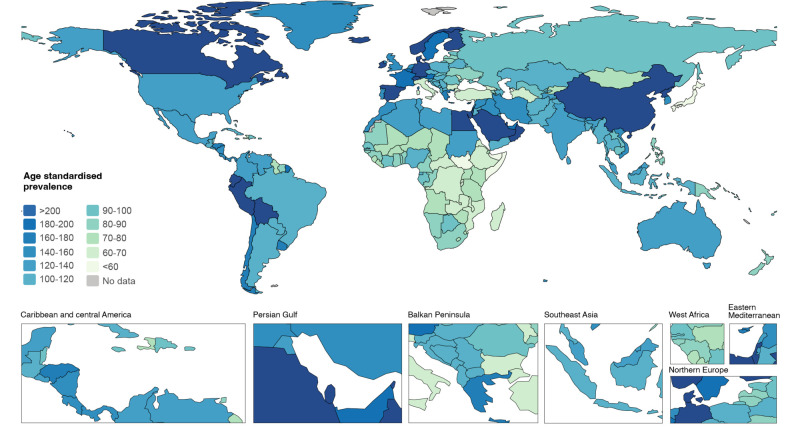
Projected age-standardized prevalence (per 100 000) of Parkinson’s disease in 2050, by country and territory for both sexes combined.
“In particular, Canada is projected to have one of the highest age-standardized prevalence rates per 100,000 in 2050,” Joyce explains. “In 2021, the estimated number of Parkinson’s cases in Canada was approximately 153,000. This figure is projected to rise by 69%, reaching 259,000 by 2050.”
Risk factors for Parkinson’s disease
Beyond regional and socioeconomic trends, a major driver of Parkinson’s disease prevalence is aging. The Global Burden of disease (2017) estimated that the proportion of the world population aged over 65 years would increase from 9.3% in 2021 to 16.9% in 2050. The inevitable consequence of population aging is an increased prevalence of Parkinson’s disease. Aging is associated with the impairment of cellular pathways, making dopamine-producing neurons more vulnerable to the pathological processes underlying the disease.
In addition to aging, environmental factors play a significant role in Parkinson’s disease risk. A number of studies have identified links between pesticide and solvent exposure—chemicals that can contaminate food and water—and increased damage to dopaminergic neurons, heightening the likelihood of disease onset. Emerging evidence also suggests a connection between climate change and Parkinson’s prevalence. If greenhouse gas emissions continue at their current rate, the world will warm even further, driving the prevalence of Parkinson’s disease upwards due to its correlation with climate warming.
Increasing urbanization and industrialization have also influenced lifestyle and dietary habits, leading to reduced physical activity and greater consumption of processed foods and dairy products. These factors may increase the risk of Type 2 diabetes, which is linked to higher rate of Parkinson’s disease. Increasing physical activity might lower the risk of Parkinson’s. The authors state, “We estimated that adherence to regular physical activity by all citizens would prevent nearly 5% of Parkinson’s Disease cases.” In addition to physical activity, they recommend coffee, tea, and vitamin E as potential protective factors for Parkinson’s disease. Research from the lab of Dr. Silke Appel-Cresswell also identifies that higher adherence to Mediterranean-type diets are associated with a higher age of onset of PD. In females, this difference was up to 17 years when comparing individuals with low versus high adherence.
As a modelling study, this research has several key limitations, including limited availability and quality of data in certain regions, a lack of information on risk factors beyond demographics, and an inability to accurately predict Parkinson’s disease prevalence in different ethnic groups or assess the impact of COVID-19.
Nevertheless, this study’s results point towards the need for tailored prevention strategies to counter the projected trends of Parkinson’s disease.
“With an aging and growing population, research needs to prioritize the development of new therapies that can slow disease progression and improve quality of life,” Joyce concludes.