Over the past decade, the NeuroImaging and NeuroComputation Core (NINC) has grown from a shared collection of imaging and computational resources into a dynamic research hub that supports scientists across disciplines at the Djavad Mowafaghian Centre for Brain Health (DMCBH). As one of the DMCBH’s core facilities, the NINC provides access to cutting-edge technologies while fostering a collaborative community dedicated to understanding the brain.
As the NINC celebrates its 10th anniversary, its impact can be measured not only in the sophisticated equipment it houses or the data it generates, but also in the discoveries, partnerships and scientific advances it has made possible.
Building a foundation for discovery
 When the DMCBH officially opened in 2014, renovations began in Koerner Pavilion to create a dedicated home for advanced imaging and computational infrastructure. One year later, the NINC officially launched, bringing together existing assets while installing its first major instrument, a Leica SP8 confocal microscope.
Since then, the facility has expanded steadily under the leadership of academic co-directors Drs. Tim Murphy and Kurt Haas, becoming an essential resource for the UBC neuroscience community. Today, the NINC team includes Managing Director Jeff LeDue, Instrumentation and Hardware Specialist Federico Bolaños and Graduate Student Microscopist in Residence Mathias Delhaye, who together support researchers in maximizing the potential of the DMCBH’s imaging and computational resources.
Beyond providing access to advanced technology, the NINC helps researchers design experiments, develop new methods, analyze complex datasets and adopt emerging imaging approaches that help accelerate scientific discovery.
Growing capabilities and expanding horizons
Over the past decade, the NINC has continuously evolved alongside the rapidly changing landscape of neuroscience research. Major milestones included the addition of tissue clearing and expansion microscopy equipment in 2017 and the launch of the NINC computer laboratory and the creation of Databinge in 2016. The facility’s growth was also accelerated through two transformative infrastructure initiatives.
The first was the in vivo Assessment of the neuroProjectome (iMAP) project, led by Dr. Tim Murphy and supported by the Canada Foundation for Innovation (CFI) Innovation Fund and John R. Evans Leaders Fund (JELF) in 2020. The project focused on expanding the spatial scales at which brain activity can be measured, enabling researchers to move seamlessly from cellular and subcellular observations to whole-brain imaging.
The second major initiative was the UBC Genes, Cells and Circuits (UBC-GC2) platform led by Dr. Mark Cembrowski and supported by a Brain Canada Platform Support Grant and CFI funding in 2025. The platform focused on integrating state-of-the-art technologies to map brain function and connectivity from molecules to circuits, unlocking insights into complex brain disorders.
Seeing the brain in new ways
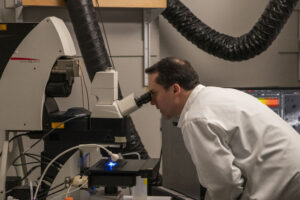 The iMAP project has significantly expanded the NINC’s imaging capabilities, providing researchers with new ways to study the brain across multiple scales.
Key additions include a custom-built three-photon microscope that enables imaging deep within the brain, a functional ultrasound system that produces MRI-like images of activity and blood flow throughout the brain, a multiphoton mesoscope that allows researchers to monitor behaviour and activity across multiple brain regions, and a lattice lightsheet microscope that rapidly captures high-resolution images of fixed tissue samples.
Together, these platforms have expanded the range of questions researchers can investigate across cells, circuits and whole-brain systems, providing a more complete picture of how the brain functions in health and disease.
A community built around collaboration
While the NINC houses a variety of advanced infrastructure, its greatest strength is the community that it supports. Each year, over 20 research laboratories participate as NINC members. Between 2022 and 2025, researchers collectively logged more than 140,000 hours using NINC resources, which is equivalent to an average of 96 hours every day for four consecutive years. The facility’s collaborative model has helped forge connections not only among neuroscientists, but also with researchers in engineering, physics, mathematics and computer science.
One of the clearest examples is Databinge, the weekly forum that began in 2016 as an informal opportunity for researchers to discuss their data and analytical methods. Over time, it has evolved into a cornerstone of the DMCBH’s open science culture, providing a welcoming space to share expertise, troubleshoot challenges and strengthen research practices. Held online every Friday afternoon, Databinge remains a valuable resource to anyone interested in data analysis, imaging and computational neuroscience.
A bright future ahead
 As the NINC enters its second decade, the pace of innovation continues to grow. Over the coming years, the facility will continue implementing technologies for the UBC-GC2 platform through funding from the Brain Canada Platform Support Grant, including the LifeCanvas SmartBatch automated tissue-clearing platform and the MBF Slice microscope. These additions will strengthen the DMCBH’s capabilities in three-dimensional spatial biology and circuit mapping.
The NINC team is also working with the UBC School of Biomedical Engineering Sequencing Core (SBME-Seq) to introduce new spatial transcriptomics technologies and install a next-generation confocal microscope capable of supporting increasingly sophisticated spatial biology studies.
Looking ahead, the NINC aims to continue expanding its capacity, supporting collaboration across Vancouver’s research community and pursuing new funding opportunities, including a proposed CFI project that would establish a satellite facility at Vancouver General Hospital.
Ten years after its launch, the NINC remains focused on the same mission that inspired its creation: providing researchers with the tools, expertise and collaborative environment needed to answer some of neuroscience’s biggest questions. As new technologies emerge and scientific challenges grow increasingly complex, the NINC is well-positioned to help the DMCBH remain at the forefront of discovery by helping researchers see the brain in new ways and accelerating advances that could ultimately improve brain health for all.