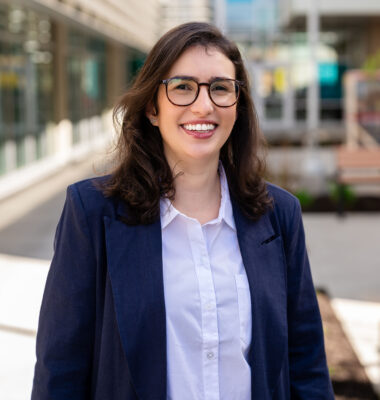
Talyta Grippe
MD (University of Brasilia); PhD (University of Minas Gerais)
Clinical Assistant Professor, Department of Medicine, Faculty of Medicine, UBC
Full Member
Talyta Grippe is a neurologist and clinical neurophysiologist specializing in movement disorders, with clinical and academic experience spanning Brazil and Canada. She is currently a Clinical Assistant Professor at the University of British Columbia and a movement disorders neurologist at the Humphreys Family Movement Disorder Clinic at Kelowna General Hospital. Dr. Grippe completed her medical and postgraduate training in Brazil, including residencies in Neurology and Clinical Neurophysiology. She subsequently moved to Canada, where she completed research and clinical fellowships in Movement Disorders and Neurophysiology at Toronto Western Hospital, University Health Network, under the supervision of Dr. Robert Chen. She holds a PhD in Neuroscience from the Federal University of Minas Gerais, where her doctoral research investigated low-intensity transcranial focused ultrasound as a novel neuromodulation approach in Parkinson’s disease.
Her clinical practice encompasses a broad range of movement disorders, including Parkinson’s disease and other parkinsonian syndromes, tremor, dystonia, myoclonus, tic disorders, and functional movement disorders. She has a particular interest in complex movement phenomenology and the use of neurophysiological techniques to support diagnosis and clinical decision making. Her academic work bridges clinical care and neuroscience, with a focus on motor physiology, clinical neurophysiology, neuroplasticity, and neuromodulation. She is particularly interested in developing objective neurophysiological tools that can improve the diagnosis, characterization, and treatment of movement disorders and facilitate the translation of advances in neuroscience into clinical practice.
Contact Info
Research Information
My research focuses on movement disorders, clinical neurophysiology, and neuromodulation, with particular interest in understanding the neurophysiological mechanisms underlying abnormal movement and translating these findings into improved diagnostic and therapeutic approaches. My work integrates electromyography (EMG), electroencephalography (EEG), transcranial magnetic stimulation (TMS), and multimodal neurophysiological techniques to investigate motor control, cortical excitability, plasticity, and movement-related brain activity. A major area of my research is the development and application of neurophysiological biomarkers in movement disorders, particularly Parkinson’s disease, dystonia, tremor, myoclonus, tic disorders, and functional movement disorders. I am especially interested in using electrophysiological testing to improve diagnostic accuracy, characterize disease mechanisms, and objectively measure treatment effects. My research also focuses on non-invasive neuromodulation, including transcranial focused ultrasound stimulation and TMS. My doctoral work investigated low-intensity transcranial focused ultrasound in Parkinson’s disease, examining its effects on cortical physiology, plasticity, and motor function. I am interested in expanding this work toward precision and physiology-guided
neuromodulation approaches. Another important component of my research is functional movement disorders, where I aim to combine clinical neurophysiology, and behavioural measures, to better understand pathophysiology, improve diagnostic certainty, and develop biomarkers that may inform treatment and rehabilitation. Overall, my goal is to build a translational research program connecting motor physiology, diagnostic neurophysiology, and neuromodulation to improve care for patients with movement disorders.
Keywords
- movement disorders
- neurophysiology
- jerky movements