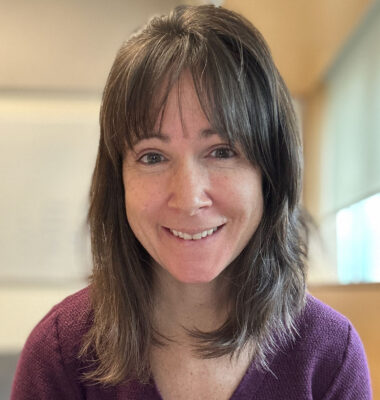
Alexis Black
PhD (UBC)
Assistant Professor, School of Audiology and Speech Science, Faculty of Medicine, UBC
Full Member
Dr. Black received her doctorate in Linguistics and Cognitive Systems from UBC in 2018. Her dissertation examined the underlying mechanisms of statistical learning. Her graduate research training involved extensive experience with adult and child perception and behavioural choice experimentation, infant looking time methods, fNIRS and EEG, special populations (neonates) and computational methods, such as meta-analysis. After her doctorate, she received an NIH F32 Postdoctoral Fellowship award to work with Dr. Richard Aslin at Yale University and Haskins Laboratories to explore the nature of word-like representations in infants, children, and adults using machine learning classifiers on EEG and fNIRS data. Together, they demonstrated that SVM analysis of EEG signals can successfully predict what word an individual subject is listening to.
In January 2020, she was hired as Assistant Professor by the School of Audiology and Speech Sciences. Since beginning at UBC, Dr. Black has received three tri-council grants (NSERC DG, SSHRC IDG, SSHRC DG) as PI and is Co-PI, collaborator and consultant on multiple others. She leads the Language and Development Lab, which has been working to adapt the SVM-decoding pipelines to observe changes in infant and adult representations during word learning tasks. The lab aims to develop a tool that can identify the word-hood status in the developing brain, and to examine how word representations form under different learning conditions (e.g., given implicit statistical sound distributions versus active labelling contexts), or across different populations (typically developing versus language-delayed).
Contact Info
Research Information
Dr. Black’s research aims to identify (i) how linguistic representations are instantiated in the mind and brain over development, and (ii) what mechanisms drive change in these representations. Critically, she is interested in developing robust tools that can detect individual differences in learning trajectories and learning states, with a long-term research goal to develop diagnostic criteria or tools that can identify infants at risk for language delay or disorder. In her research lab, they integrate across neural (EEG, fNIRS), physiological (eye tracking), and behavioural measures to achieve these aims.
PublicationsKeywords
- language acquisition
- speech perception
- infancy
- EEG
- eye-tracking
- statistical learning
- neural decoding