
- This event has passed.
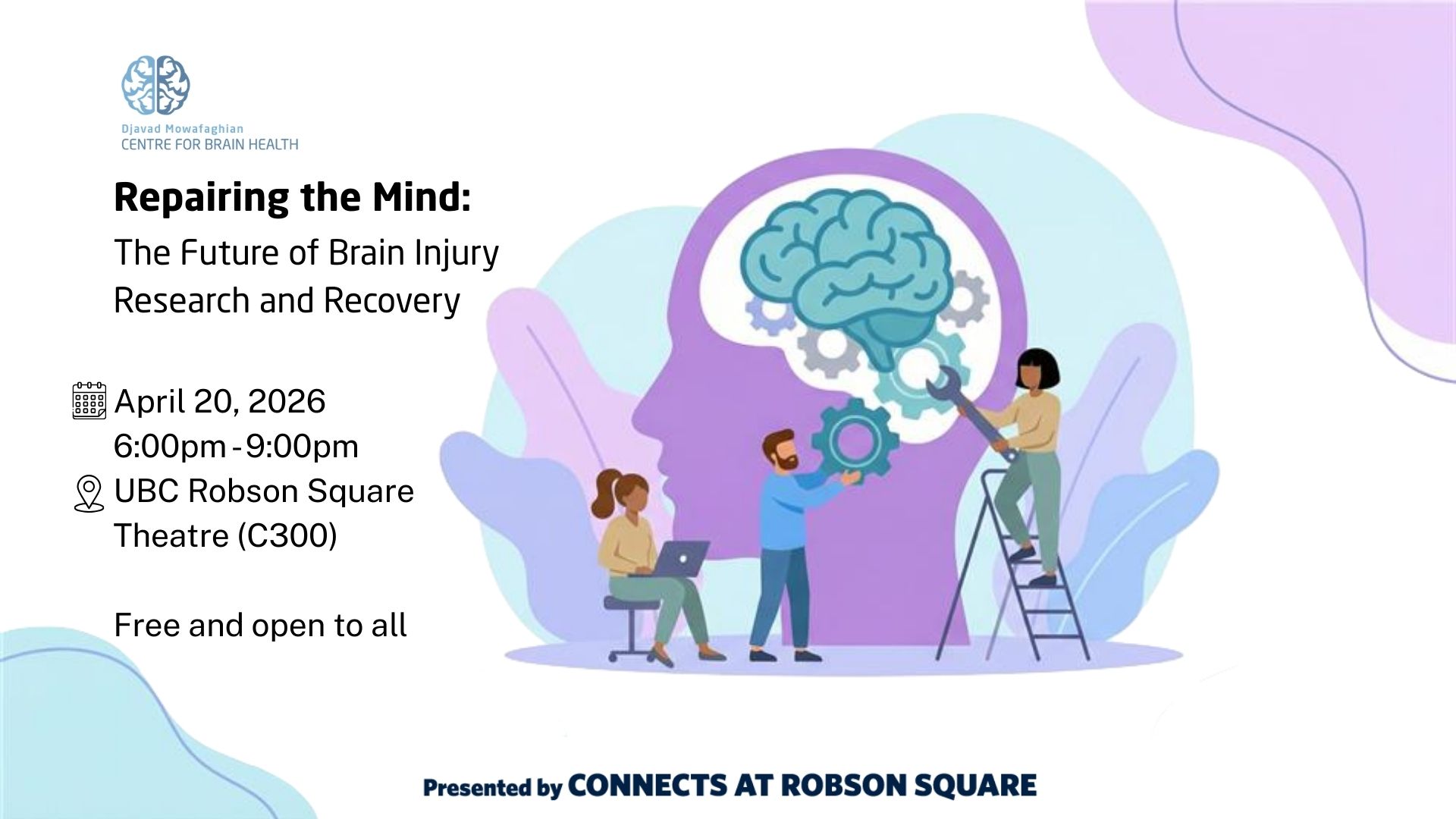
Repairing the Mind brings together leading UBC researchers who are transforming how we detect, understand, and treat brain injuries and disorders. From simple blood tests that catch concussion and dementia earlier, to personalized treatments for spinal cord injuries, to new technologies that help patients communicate even when they appear unresponsive—this event will highlight how research is creating real possibilities for recovery. These breakthroughs are already reshaping how we support brain health through faster answers, more precise care, and renewed hope for patients and families.
UBC Connects at Robson Square, in partnership with the Djavad Mowafaghian Centre for Brain Health, presents leading UBC scholars Dr. Cheryl Wellington, Dr. Wolfram Tetzlaff and Dr. Stefanie Blain-Moraes in a conversation about the future of brain injury research and recovery.
Free and open to all.
Speaker bios:
Dr. Cheryl Wellington is Professor and Vice Chair of Research in the Department of Pathology and Laboratory Medicine at UBC. Dr. Wellington’s lab takes a translational approach to researching brain health, focusing on both the fundamental biological mechanisms underlying Alzheimer’s disease and traumatic brain injury (TBI) and the clinical utility of fluid biomarkers for the diagnosis and treatment of a variety of neurological conditions. Dr. Wellington also holds multiple leadership positions in both the dementia and neurotrauma communities, and is a Fellow of the Canadian Academy of Health Sciences.
Dr. Wolfram Tetzlaff is Professor in the Departments of Zoology and Surgery at UBC and former Director of ICORD (International Collaboration on Repair Discoveries). Dr. Tetzlaff’s research focuses on developing experimental strategies for neuroprotection and neural repair, with an emphasis on understanding why the spinal cord fails to regenerate after spinal cord injury. His ultimate goal is to combine multiple strategies to promote nerve cell growth and improve recovery, helping to advance new therapies for spinal cord and brain injury. He recently received the King Charles III Coronation Medals, recognizing him as a spinal cord injury research trailblazer.
Dr. Stefanie Blain-Moraes is an Associate Professor in the School of Biomedical Engineering and Department of Occupational Sciences and Occupational Therapy at UBC. She leads the Biosignal Interaction and Personhood Technology (BIAPT) Lab, which aims to develop technologies to assess consciousness and sustain relationships with minimally communicative persons. Her research program has involved persons in disorders of consciousness and palliative care; adults with dementia, Parkinson’s disease and amyotrophic lateral sclerosis; and children with autism and severe disabilities. Recently, she was elected as a Member of the Royal Society of Canada’s College of New Scholars, Artists, and Scientists.
Moderator:
Dr. Shernaz Bamji is a Professor in the Department of Cellular and Physiological Sciences and Co-Director of the Djavad Mowafaghian Centre for Brain Health Her research is focused on understanding the molecular and cellular mechanisms underlying neural connectivity and synaptic plasticity. Her work has provided key insights into the fundamental mechanisms underlying learning and memory, as well as how these processes are disrupted in neurodevelopmental and neurodegenerative disorders such as intellectual disabilities, schizophrenia, autism and Alzheimer’s disease.