
- This event has passed.
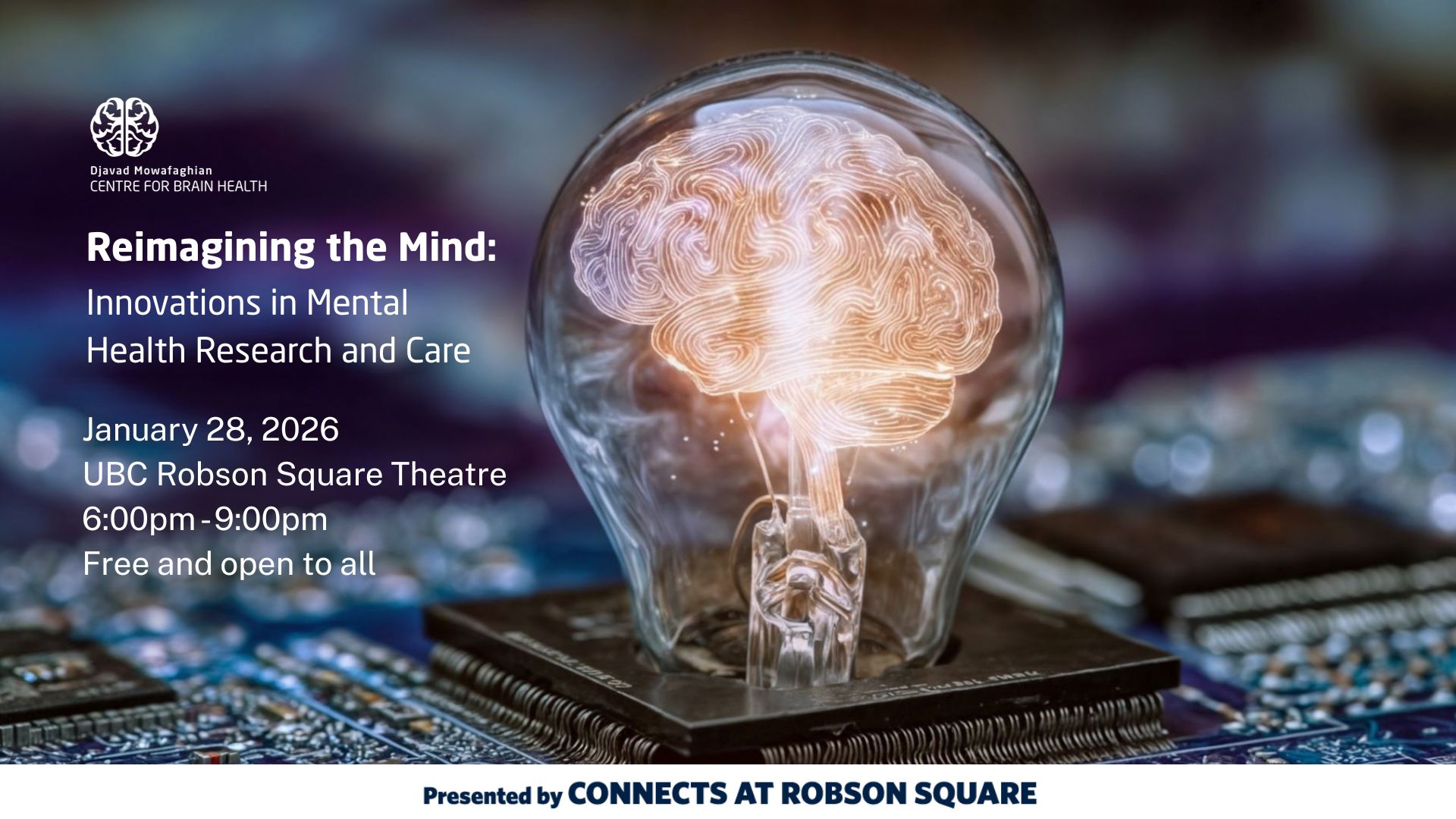
Mental health research is entering a bold new era. As rates of depression, anxiety, and other psychiatric conditions continue to rise, researchers at UBC are developing groundbreaking tools to offer new possibilities for diagnosis, treatment, and recovery. From brain stimulation therapies like TMS, to ethical applications of social robotics, to movie-based neuroimaging tools, discover how innovation is expanding the ways we support mental wellness across the lifespan.
UBC Connects at Robson Square, in partnership with the Djavad Mowafaghian Centre for Brain Health, presents leading UBC scholars Dr. Fidel Vila-Rodriguez, Dr. Julie Robillard, and Dr. Tamara Vanderwal in a conversation about the technologies reshaping mental health care.
Free and open to all.
Talk descriptions:
Neuromodulation Treatments for Neuropsychiatric Disorders in 2026 and Beyond
Dr. Vila-Rodriguez will introduce learners to how several neurotechnologies work to non-invasively treat neuropsychiatric disorders, including, but not limited to, depression, PTSD, schizophrenia or dementia.
Are friends electric? Social technologies and mental health care
Dr. Robillard will review how new technologies like AI chatbots and social robots can help, and harm, our mental health. She will explore the ethics of our relationships with technology and the role of these relationships in mental health care.
Movies in the magnet: Using movie-fMRI to better understand child psychiatric disorders
We still know very little about the biological basis of major psychiatric disorders, and this is especially true in children and youth. Dr. Vanderwal’s talk is about a research method called movie-fMRI, where research participants undergo brain scans while they watch movies. It will describe what these studies are like, and how researchers are trying to use the movie-watching data to discover new information about the brain in child psychiatric disorders.
Speaker bios:
Dr. Fidel Vila-Rodriguez is an Associate Professor in UBC’s Department of Psychiatry and Director of the Non-Invasive Neurostimulation Therapies (NINET) Laboratory. As a clinician-scientist, his work focuses on neurotechnologies to identify dysfunctional brain-circuitry underlying brain disorders and applying neuromodulation techniques to treat neuropsychiatric conditions. One of his primary research interests is the application of repetitive Transcranial Magnetic Stimulation (rTMS) in treatment-resistant depression.
Dr. Julie Robillard is an Associate Professor of Neurology at UBC and Scientist in Patient Experience at BC Children’s and Women’s Hospitals. She leads the Neuroscience, Engagement and Smart Tech (NEST) lab within Neuroethics Canada, where she brings her background in neuroscience and biomedical ethics to the evaluation and development of social technologies to support brain health across the lifespan. A particular interest of her research is the integration of emotion modeling in a wide range of technologies, from social media resources to social robotics.
Dr. Tamara Vanderwal is a child psychiatrist at BC Children’s Hospital, an Assistant Professor in the Department of Psychiatry at UBC, and a clinician scientist at BC Children’s Hospital Research Institute, where she directs the Naturalistic Neuroimaging Lab. Her research aims to learn new information about brain differences in adolescent depression and other child psychiatric disorders. Her lab uses movies during functional magnetic resonance imaging (fMRI) brain scans to study brain function in children and youth while their brains are actively processing the complex information in the movies. Dr. Vanderwal’s work combining neuroscience and art has been featured at the Imagine Science Film Festival and at MoMA Studios.
Moderator:
Dr. Lynn Raymond is a Professor in UBC’s Department of Psychiatry, Co-Director of the Djavad Mowafaghian Centre for Brain Health and Clinic Director of the Centre for Huntington Disease. As a clinician-scientist, she brings a unique perspective to her work on neurodegenerative diseases, bridging the gap between research and patient care. Her lab investigates the mechanisms that lead to Huntington Disease, focusing on changes in brain circuits and glutamate receptor function.